
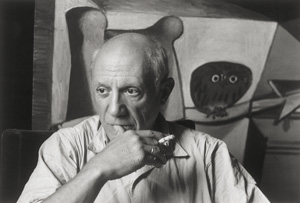
Pablo Picasso, Paris. 1948. Gelatin silver print, printed in 1981. 23,3 x 34,5 cm (sheet 30,3 x 40,5 cm). Photographer's estate stamp and signed by Max Scheler in ink on verso.
Literatur: Max Scheler and Matthias Harder, eds. Herbert List. The Monograph. Munich 2000, ill. p. 205 (image from the same sitting).
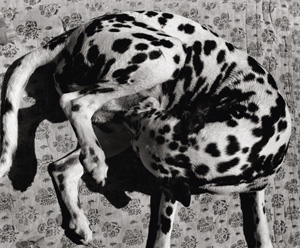
Nero, Portofino. 1937. Vintage ferrotyped gelatin silver print. 10,4 x 12,6 cm. Titled and dated in pencil, possibly in the photographer's hand; Black Star Agency, New York credit stamp and cropped annotations in ink on verso.
Literatur: Günter Metken. Herbert List: Fotografien 1930-1970. Munich: 1976, ill. Nr. 22 (similar image dated 1936).
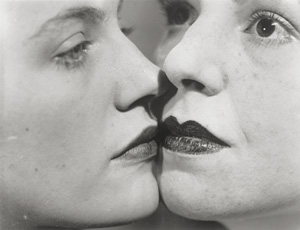
Le baiser (The Kiss). 1930. Gelatin silver print, printed by Pierre Gassmann in 1982. 23 x 30 cm (sheet 30,4 x 38,3 cm). Partial "Man Ray Paris" stamp, "Tirage original réalisé par Pierre Gassmann" stamp and "A.D.A.G.P Paris" copyright stamp on the verso.
A central figure of Dada and Surrealism, Man Ray expanded the expressive possibilities of photography through techniques such as solarization and his cameraless "rayographs". In Le baiser, he brings the faces of Lee Miller, his collaborator and fellow photographer, and an unidentified woman into a tightly framed composition that transforms an intimate gesture into a study of form and desire.
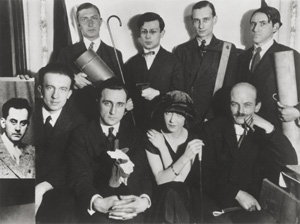
Rayographs; Portrait of the Paris Dada group. 1921-23. 3 gelatin silver prints, 2 on Agfa paper, printed in 1978 and 1991. The 2 rayograph prints mounted along the upper edge to grey board. 2 ca. 29,5 x 22,5 cm (mount 43 x 34 cm) and 19,8 x 26,5 cm (sheet 24 x 30 cm). Each with Griffelkunst edition stamp; the 2 rayograph prints also with Man Ray's signature stamp and rayograph stamp, as well as signed and dated in pencil by the estate executor on verso; Griffelkunst stamp on mount verso.
Man Ray made his original "rayographs" without a camera, arranging objects on light-sensitive paper and exposing them to light. Moving between abstraction and representation, these experimental images became an important part of his contribution to the Dada and Surrealist movements. The present group includes 2 later prints after rayographs, alongside a portrait of the Paris Dada group.
Literatur: Jean-Hubert Martin, ed. Man Ray: Photographs. London: Thames and Hudson, 1991, ill. pp. 140-141.
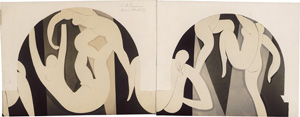
Matisse, Henri
Photographic reproduction of 2 panels of Matisse's triptych mural La danse de Merion
Los 4209
Schätzung
2.000€ (US$ 2,299)
Photographer: Wolfgang Vennemann (1908-1990). Photographic reproduction of 2 panels of Henri Matisse's mural La Danse de Merion. 1932/33. 2 vintage gelatin silver prints, joined together with linen tape on the verso. 16,8 x 43,8 cm. Left print dedicated to Hans Purrmann and signed by Henri Matisse in pencil in the upper right corner; each print with the photographer's stamp on the verso.
Commissioned by Albert C. Barnes in 1930, La Danse de Merion was designed for the three arches above the windows of the main gallery at the Barnes Foundation in Merion, Pennsylvania. Matisse worked on the monumental mural in his studio in Nice, developing its composition with coloured paper cut-outs before completing the final version in 1933. Its simplified forms and expressive use of colour anticipate the cut-outs that would become central to his later work.
Wolfgang Vennemann, son of the photographer Albert Vennemann, lived near Monte Carlo in the mid-1930s, where he photographed the work and surroundings of artists on the French Riviera. The present reproduction was dedicated by Matisse to the German painter Hans Purrmann, a former student of the artist. A related photographic reproduction of the complete mural can be seen in a 1948 photograph of Matisse's apartment.
Provenienz: From the estate of Hans Purrmann.
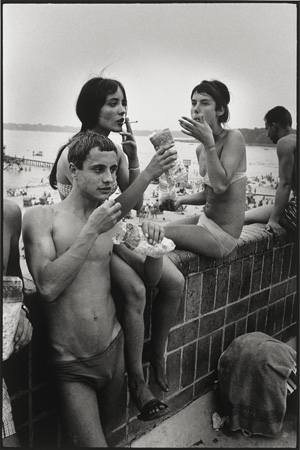
Freunde am Wannsee (Stöffie, Magda und Evi am Strandbad Wannsee mit Popcorn). 1959. Gelatin silver print, printed later. 37 x 24,5 cm (sheet 40,7 x 30,2 cm). Signed, titled, dated and dedicated by the photographer in pencil on the verso.
The American-German photographer Will McBride is celebrated for his candid and empathetic photographs of youth, sexuality and everyday life in postwar Germany. With an unguarded approach, he captured the changing attitudes and experiences of a younger generation. His compassionate eye and the trust he established with his subjects resulted in photographs that remain striking for their honesty, intimacy and emotional depth.
Literatur: Will Mc Bride. I, Will McBride. Cologne: Könemann, 1997, ill. p. 233.
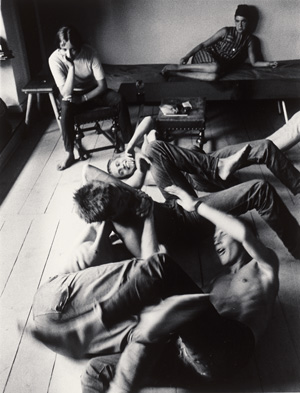
McBride, Will
Freunde raufen in Jan's Zimmer, Berlin Zehlendorf West
Los 4211
Schätzung
1.200€ (US$ 1,379)
Freunde raufen in Jan's Zimmer, Berlin Zehlendorf West. 1959. Gelatin silver print, printed 2012. 46,5 x 35,5 cm (sheet 61 x 50,2 cm). Signed, titled, dated and dedicated by the photographer in pencil on the verso.
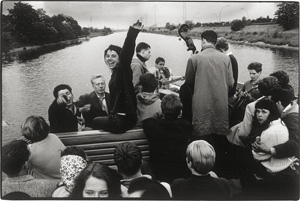
Riverboat, Berlin. 1959. Gelatin silver print, printed later. 18,5 x 27,8 cm (sheet 23,7 x 30,4 cm). Signed, titled, dated and annotated "Mein Lieblings Bild" by the photographer in pencil on the verso.
Literatur: Will Mc Bride. I, Will McBride. Cologne: Könemann, 1997, ill. pp. 122-123.
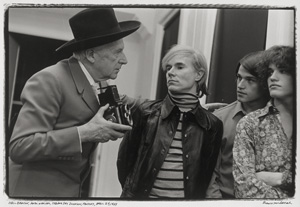
McDarrah, Fred W.
Cecil Beaton, Andy Warhol, Jeb and Jay Johnson, Factory, April 24, 1969
Los 4213
Schätzung
2.500€ (US$ 2,874)
Cecil Beaton, Andy Warhol, Jeb and Jay Johnson, Factory, April 24, 1969. Gelatin silver print, printed 1992. 31,5 x 46,5 cm (sheet 40,2 x 50,5 cm). Titled, dated and signed by the photographer in ink in the lower margin; photographer's copyright stamp, therein dated 1992, on the verso.
A photographer for The Village Voice, Fred W. McDarrah was one of the foremost chroniclers of New York's avant-garde. His photographs of Andy Warhol, the Beat Generation and the Fluxus movement are important visual records of the city's cultural life. This image captures the British photographer and designer Cecil Beaton visiting Warhol at his Factory, accompanied by Jeb and Jay Johnson.
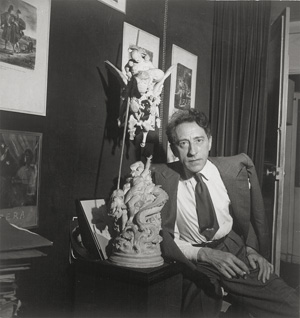
Jean Cocteau, Palais Royal, Paris. 1944. Vintage gelatin silver print, hinge-mounted in mat. 16 x 15,2 cm. Publisher's copyright stamp, date stamp, annotations in pencil and typed press text label on the verso.
The American photographer Lee Miller began her career as a fashion model in 1920s New York before moving to Paris, where she established herself as a fashion and fine-art photographer. During World War II, she worked as a war correspondent for Vogue, documenting the London Blitz, the liberation of Paris and the concentration camps at Buchenwald and Dachau. Once known primarily as Man Ray's muse and lover, Miller later gained recognition for her own artistic and documentary achievements, thanks in part to her son's efforts to preserve and promote her work. In this portrait, she captures the French writer and artist Jean Cocteau in his Paris apartment during the final years of the war.
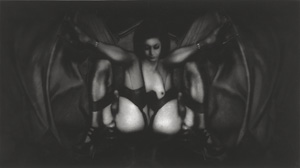
Photomontage. 1972. Vintage gelatin silver print. 16,3 x 23,7 cm. Signed, editioned “28/38” and dated by the photographer in pencil in the lower margin.
The French artist Pierre Molinier developed a distinctive photographic practice centred on desire, androgyny and the transformation of the body. Combining self-portraits with images of models and mannequins, he used photomontage to construct provocative, dreamlike compositions that challenged conventional notions of identity and sexuality. Beigegeben: 1 of 38 numbered (28/38) copies of the book Peter Gorsen and Pierre Molinier. Pierre Molinier; lui-meme. Essay über den surrealistischen Hermaphroditen. Munich: Rogner & Bernhard, 1972. In original silk slipcase (some tears). - Edges slightly rubbed, some scuff marks, otherwise in good condition.
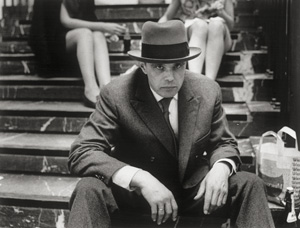
Joseph Beuys, Installation of the Ströher Collection, Neue Pinakothek, Munich. 1968. Gelatin silver print, printed later. 22,5 x 29 cm (sheet 23,5 x 30,5 cm). Signed, annotated and dated by the photographer in pencil and blue crayon, and photographer's stamp on the verso.
The German photographer Stefan Moses began his career in Breslau and worked as a theatre photographer in Weimar after World War II. From 1950, he was based in Munich and photographed for Stern magazine. His major series “Deutsche” and “Abschied und Anfang” offer a wide-ranging portrait of people in West and East Germany. He also photographed prominent cultural figures, including Thomas Mann, Erich Kästner, Theodor W. Adorno, Otto Dix, Max Frisch and Martin Mayer. This photograph shows Joseph Beuys at the installation of the Ströher Collection in Munich in 1968.
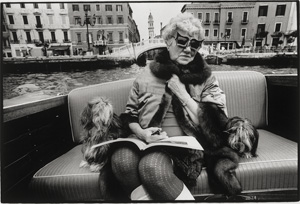
Peggy Guggenheim, Venice. 1969. Gelatin silver print, printed later. 25,5 x 38 cm (sheet 30,2 x 40,5 cm). Signed, titled and dated "1974" by the photographer in pencil and photographer's stamp on the verso.
Literatur: Ulrich Pohlmann, Matthias Harder, eds. Stefan Moses: Die Monografie. Fotografien 1947 bis heute. Munich: Schirmer/Mosel, 2002, ill. p.169 (variant)
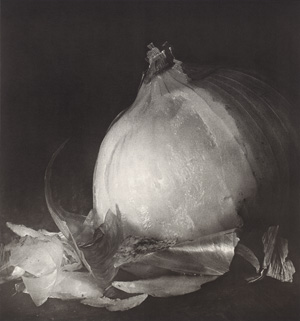
Cipolla da ... 1996. Large-format collotype, mounted in photo corners in mat. 40,5 x 39,7 cm (sheet 71,8 x 59,8 cm). Monogrammed, titled, dated and editioned "16/27" by the photographer in pencil in the lower margin.
Konrad R. Müller was an important German postwar portrait photographer. Over several decades, he photographed numerous politicians, as well as writers, musicians, actors and mountaineers. His landscapes and photo essays for publications including Süddeutsche Zeitung, Die Zeit, Stern, Profil, L'Express and Time, alongside the work offered here, reveal other facets of his photographic practice.
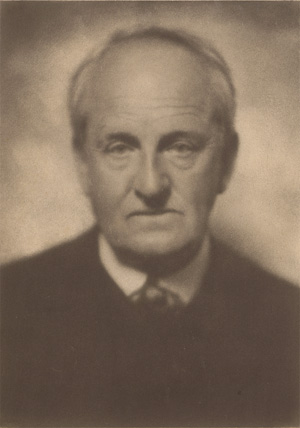
Portrait of Gerhart Hauptmann (1862-1946). Ca. 1922. Vintage bromoil print, mounted to board. 37,6 x 26,2 cm. Signed by the photographer in pencil and sitter's name handwritten in ink in the lower margin.
Alongside his work in film photography, Hans Natge produced numerous studio portraits of celebrities and figures from society. His early portraiture reflects an interest in Pictorialism and experimentation with pigment processes, lending his prints a distinctive painterly quality. This bromoil portrait depicts the German dramatist and novelist Gerhart Hauptmann.
[*]: Regelbesteuert gemäß Auktionsbedingungen. [^]: Ausgleich von Einfuhr-Umsatzsteuer.
* Alle Angaben inkl. 25% Regelaufgeld ohne MwSt. und ohne Gewähr – Irrtum vorbehalten.
Galerie Bassenge
Erdener Str. 5A
14193 Berlin
Öffnungszeiten:
Montag bis Donnerstag, 10–18 Uhr,
Freitag, 10–16 Uhr
Telefon: +49 30 8938029-0
Fax: +49 30 8918025
E-Mail: info (at) bassenge.com
Impressum
Datenschutzerklärung
© 2026 Galerie Gerda Bassenge
Galerie Bassenge
Erdener Str. 5A
14193 Berlin
Öffnungszeiten:
Montag bis Donnerstag, 10–18 Uhr,
Freitag, 10–16 Uhr
Telefon: +49 30 8938029-0
Fax: +49 30 8918025
E-Mail: info (at) bassenge.com
Impressum
Datenschutzerklärung
© 2026 Galerie Gerda Bassenge