
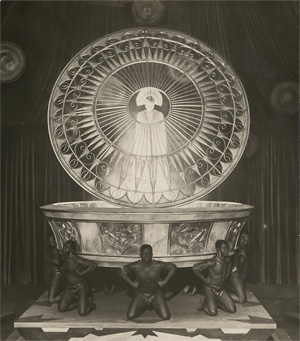
Photographer: Hans Natge (1893-1976). Scenes from the film Faust. 1926. 34 vintage gelatin silver prints on chamois paper. Each ca. 12,8 x 16,8 cm and reverse.
Hans Natge was among the leading German film photographers of the 1920s-1940s. His early work was influenced by Pictorialism, and he experimented with various pigment processes. His photographs from F.W. Murnau's Faust (1926) demonstrate his distinctive approach to film photography, capturing the atmospheric lighting, dramatic compositions and expressive visual language of German Expressionist cinema. Most of the images in the present set depict the principal actors Gösta Ekman and Emil Jannings.
Film Photography
Scenes form the film "Am Rande der Welt"
Los 4146
Schätzung
500€ (US$ 575)
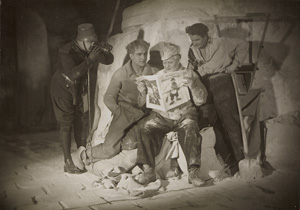
Photographer: Hans Natge (1893-1976). Scenes from the film Am Rande der Welt. 1927. 26 vintage gelatin silver prints on ivory paper. Each ca. 11,2 x 16 cm and reverse.
Am Rande der Welt (At the Edge of the World) is a 1927 German silent anti-war film directed by Karl Grune, starring Albert Steinrück, William Dieterle and Brigitte Helm. It was shot at the Babelsberg Studios in Berlin. Robert Neppach oversaw the film's art direction and designed the sets. The film was so heavily cut by the management of UFA that Grune tried to have his name removed from the credits and publicly criticized them in an open letter.
Film Photography
Douglas Fairbanks and Mary Pickford visit the UFA studios, Babelsberg
Los 4147
Schätzung
500€ (US$ 575)
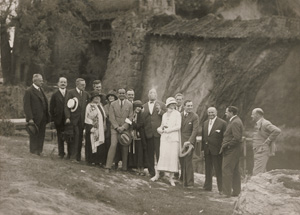
Photographer unknown. Douglas Fairbanks and Mary Pickford visit the UFA studios, Babelsberg. 1924. 6 vintage gelatin silver prints on ivory paper. Each ca. 12,5 x 17 cm and reverse.
The iconic and widely popular film couple Mary Pickford and Douglas Fairbanks visited the Babelsberg Studios (then UFA studios) in Potsdam-Babelsberg during their European tour in 1924. They visited the historic Babelsberg film lots, meeting prominent German film figures and actors, such as Emil Jannings. This marked their first trip to Germany together, bridging the golden age of Hollywood and Weimar-era German cinema.
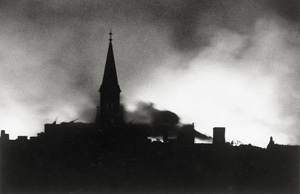
Brennendes Berlin (Wedding Humboldthain). 1943. Gelatin silver print, printed 1980s. 16,4 x 25,3 cm (sheet 19,2 x 26,7 cm). Signed and annotated by the photographer in pencil and photographer's stamp on the verso.
Arno Fischer’s documentary photographs of East and West Berlin from the 1950s-1960s offer a nuanced view of the city during a period of division and transformation. Marked by observational clarity and a sensitivity to everyday life, they capture both the challenges and resilience of its inhabitants and function as both historical records and autonomous works of art. This is Fischer’s earliest photograph taken at age 16 in his Berlin neighborhood where he was born.
Literatur: Elke aus dem Moore and Matthias Flügge, eds. Arno Fischer: Fotografie (exhibition catalog). Ostfildern: Hatje Cantz, 2009, ill. p. 29.
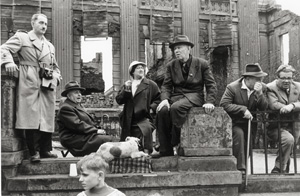
Ost-Berlin, Unter den Linden. 1956. Gelatin silver print, printed later. 15 x 22 cm (18 x 24 cm). Signed by the photographer in pencil on the verso.
Literatur: Elke aus dem Moore (ed.). Arno Fischer: Fotografie (exhibition catalog). Ostfildern: Hatje Cantz, 2009, ill. p. 33.
Finkelstein, Nat
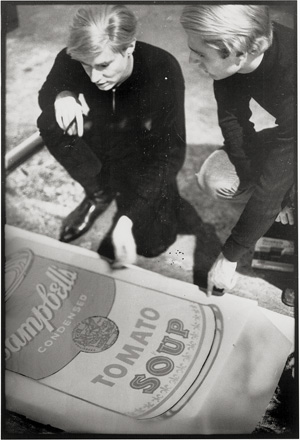
Andy Warhol working on Campell's Soup silkscreen with assistant at the Factory
Los 4150
Schätzung
750€ (US$ 862)
Andy Warhol working on Campbell's Soup silkscreen with assistant at the Factory. Circa 1968. Ferrotyped gelatin silver print on RC paper, printed later. 23,5 x 16 cm (25,2 x 20,2 cm ). Photographer's copyright stamp on the verso.
Nat Finkelstein studied photography under Alexey Brodovitch, art director of Harper's Bazaar, and worked as a photojournalist for the Black Star and PIX agencies, documenting New York's political and cultural subcultures during the 1960s. In 1964, he began photographing Andy Warhol's Factory, capturing its artists, personalities and creative activities over several years. His photographs from this period constitute an important visual record of New York's avant-garde scene. The present image shows Warhol working on a silkscreen featuring his iconic Campbell's Soup motif, which gained prominence with his 1962 series. Warhol's use of silkscreen printing, a technique borrowed from commercial production, enabled the serial repetition of images and became a defining feature of his artistic practice.
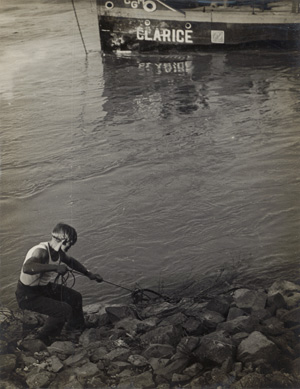
Worker Pulling a Cargo Barge. 1933. Vintage gelatin silver print, mounted to board. 22,5 x 17,5 cm (mount 33 x 25,2 cm). Signed and dated by the photographer in pencil and annotated in another hand in pencil on the mount verso.
Ladislav Foltyn studied at the Bauhaus from 1929-1932, where he attended the photography course directed by Walter Peterhans. Alongside his work as an architect, he pursued photography, focusing mainly on still lifes. He later wrote several books on architecture, including Slowakische Architektur und die tschechische Avantgarde 1918-1939. His work is in the collection of the National Gallery of Art Washington, D.C.
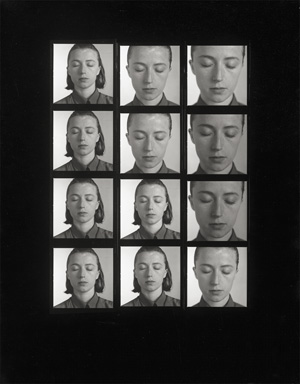
Cindy Sherman Times Twelve. 1987. Gelatin silver print, printed in 2009. 25,1 x 18,2 cm (sheet 35,4 x 27,7 cm). Signed, titled, dedicated, dated and with copyright notation by the photographer in pencil on the verso.
This striking series of portraits depicts the conceptual artist Cindy Sherman in her Walker Street studio in New York City. Arranged in three photographic strips comprising twelve sequential images, the composition recalls the format of an analogue photo booth. Depicted without her characteristic elaborate costumes, wigs or disguises, Sherman appears in a succession of subtly shifting expressions and poses, offering an unusual perspective on an artist renowned for her exploration of identity and self-transformation. An image from this series, entitled Cindy Sherman, Tabula Rasa, is held in the collection of the Museum of Modern Art, New York.
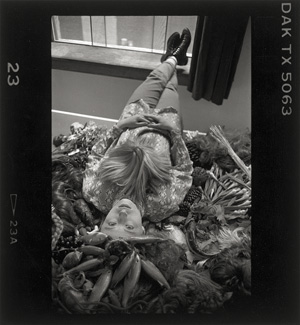
Cindy Sherman, New York City. 1987. Gelatin silver print, printed 2009. 26,7 x 24,7 cm (sheet 35,3 x 27,8 cm). Signed, titled, dedicated, dated and copyrighted by the photographer in pencil on the verso.
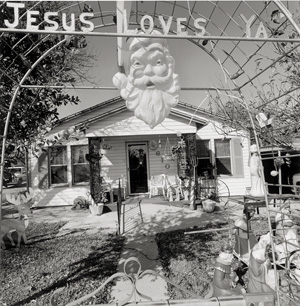
San Angelo, Texas. 1997. Gelatin silver print. 37,5 x 37,1 cm (sheet 50,5 x 40,5 cm). Signed by the photographer in pencil, with photographer's publication and limitation stamp, as well as title and archive number in pencil on the verso.
Lee Friedlander is one of the most influential figures in American street and documentary photography, renowned for his distinctive exploration of the American "social landscape". His complex compositions, often incorporating reflections, signage, fragmented perspectives and layered visual elements, transformed seemingly ordinary scenes into intricate photographic studies. Alongside Diane Arbus and Garry Winogrand, he was featured in the landmark exhibition "New Documents" at the Museum of Modern Art, New York, in 1967, where he was also honored with a major retrospective in 2005.
Provenienz: Galerie Thomas Zander, Cologne; Grisebach, Auction 238, Lot 2206, June 3, 2015
Literatur: Lee Friedlander. Christmas. New York: Eakins Press Foundation, 2025, ill. front cover.
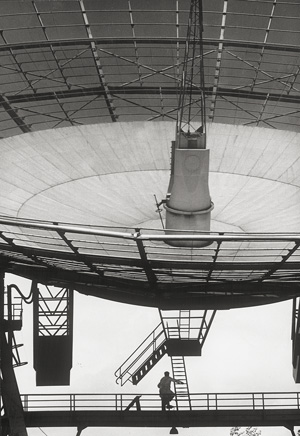
Friedemann, Paul
Radiospiegel (Radio mirror), Heinrich-Hertz-Institute, Berlin; GDR workers on the job
Los 4155
Schätzung
400€ (US$ 460)
Radiospiegel (Radio mirror), Heinrich-Hertz-Institute, Berlin; GDR workers on the job. 1960s. 2 vintage large-format ferrotyped gelatin silver prints. Each circa 39 x 27 cm. Each with photographer's stamp, exhibition stamp, annotated in pencil and 1 with archive label on the verso.
Paul Friedemann was a German photojournalist and an important representative of post-war photography in the GDR. From 1951 onwards, he worked for the illustrated magazine Zeit im Bild, documenting political events, industrial developments and everyday life in East Germany. A member of the influential photographers' group Signum, founded in 1965, Friedemann combined a documentary approach with carefully structured compositions.
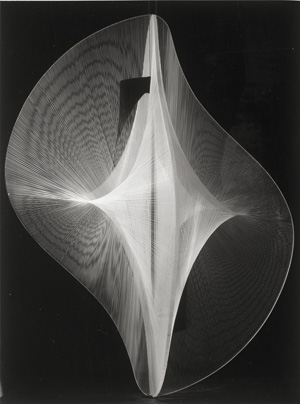
Gabo, Naum
Linear Construction in Space No.1 and Linear Construction in Space No. 2 by Naum Gabo
Los 4156
Schätzung
500€ (US$ 575)
Photographers: Oliver Baker (active 1930s-1960s) and John Brook (1924-2016). Linear Construction in Space No.1 and Linear Construction in Space No. 2 by Naum Gabo (1890-1977). 1943, 1949. 2 vintage ferrotyped gelatin silver prints. Each circa 25,5 x 20,5 cm. Each with photographer's stamp on the verso.
Naum Gabo was a pioneering figure of Russian Constructivism whose innovative approach to sculpture profoundly influenced the development of modern abstract art. Rejecting traditional notions of sculptural mass and volume, he explored the interplay of space, light and geometric form, frequently employing modern materials such as Perspex and nylon filament. His celebrated Linear Construction series, begun in the early 1940s, exemplifies these principles, using finely stretched threads to create intricate spatial structures in which empty space becomes an integral element of the composition. The present two photographs document works from this important series, illustrating Gabo's radical redefinition of sculptural form.
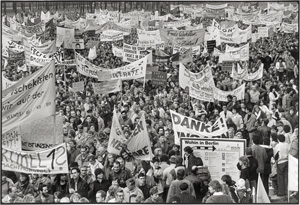
Berlin Ost, 4.11.1989. Vintage gelatin silver print. 27,2 x 40 cm (sheet 38 x 49 cm). Titled and signed by the photographer in ink in the lower margin; titled and dated in ink, with photographer's stamp and annotations in pencil on the verso.
Frank Gaudlitz studied photography under Arno Fischer at the Academy of Visual Arts in Leipzig from 1987 to 1991. Since then, he has undertaken extensive long-term photographic projects, particularly in Russia, Eastern Europe and South America, documenting social and political transformations and their impact on individual lives. His work has received numerous awards and is represented in major collections, including the Berlinische Galerie and the Deutsches Historisches Museum, Berlin.
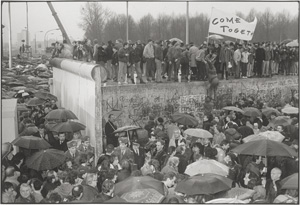
Brandenburger Tor, 23.12.1989. Vintage gelatin silver print. 25,5 x 37,7 cm (sheet 38,5 x 48,5 cm). Titled and signed in ink by the photographer in the lower margin; photographer's stamp on the verso.
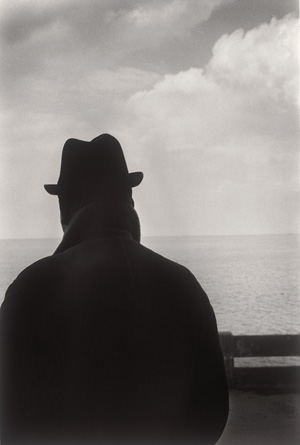
Mann mit Hut. 1979. Vintage gelatin silver print on Agfa paper. 32,5 x 22 cm (38,7 x 29 cm). Signed, titled and dated by the photographer in pencil on the verso.
André Gelpke is a German-Swiss photographer who studied under Otto Steinert at the Folkwangschule in Essen from 1969 to 1975. In 1975, he co-founded the photographic agency Visum with Rudi Meisel and Gerd Ludwig. Increasingly turning towards artistic photography, Gelpke, alongside contemporaries such as Heinrich Riebesehl and Michael Schmidt, contributed significantly to the recognition of photography as an independent art form in Germany.
[*]: Regelbesteuert gemäß Auktionsbedingungen. [^]: Ausgleich von Einfuhr-Umsatzsteuer.
* Alle Angaben inkl. 25% Regelaufgeld ohne MwSt. und ohne Gewähr – Irrtum vorbehalten.
Galerie Bassenge
Erdener Str. 5A
14193 Berlin
Öffnungszeiten:
Montag bis Donnerstag, 10–18 Uhr,
Freitag, 10–16 Uhr
Telefon: +49 30 8938029-0
Fax: +49 30 8918025
E-Mail: info (at) bassenge.com
Impressum
Datenschutzerklärung
© 2026 Galerie Gerda Bassenge
Galerie Bassenge
Erdener Str. 5A
14193 Berlin
Öffnungszeiten:
Montag bis Donnerstag, 10–18 Uhr,
Freitag, 10–16 Uhr
Telefon: +49 30 8938029-0
Fax: +49 30 8918025
E-Mail: info (at) bassenge.com
Impressum
Datenschutzerklärung
© 2026 Galerie Gerda Bassenge