
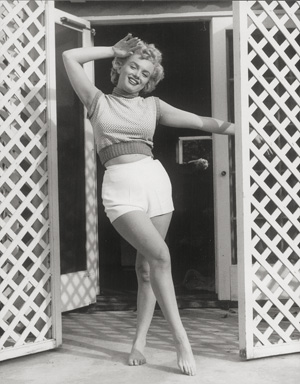
Dienes, André de
Marilyn Monroe, Hotel Bel Air, Los Angeles
Los 4130
Schätzung
750€ (US$ 862)
Marilyn Monroe, Hotel Bel-Air, Los Angeles. 1953. Gelatin silver print, printed later. 25,4 x 20 cm. Photographer's "1401 Sunset Plaza Drive, Hollywood, Calif. 90069" stamp on the verso.
André de Dienes was a prominent Hungarian-American photographer known for his early glamor, nude, and landscape photography, and most famously for launching the modeling career of Marilyn Monroe. In 1945, de Dienes was the first professional photographer who hired 19-year-old Norma Jeane Baker, an aspiring model. Fascinated by her raw talent, he took her on a road trip across California, Nevada, and New Mexico. Their professional relationship evolved into a brief romantic affair and a lasting friendship. He continued to photograph her when she became known as Marilyn Monroe in 1946, 1952 and 1953.
Literatur: André de Dienes. Marilyn mon Amour: The Private Album of André de Dienes. London: Bracken, 1993, ill. unpaginated.
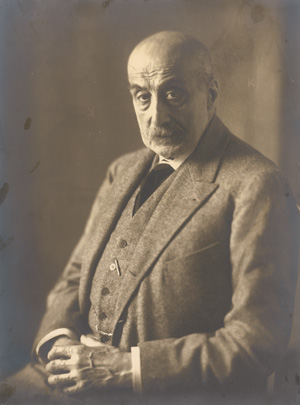
Max Liebermann. 1927. Vintage gelatin silver print. 22,5 x 16,7 cm. Archive stamp and annotated in pencil on the verso.
This portrait of Max Liebermann is from the same year in which Dührkoop took an official commemorative portrait for his 80th birthday.
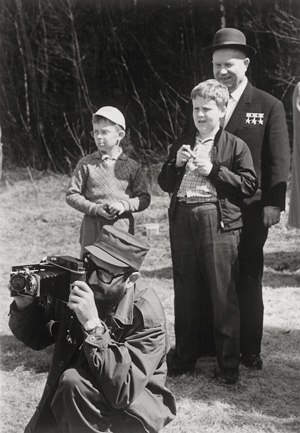
Egorov, Vasily V.
Nikita Khrushchev and Fidel Castro with Khrushchev's grandsons
Los 4132
Schätzung
500€ (US$ 575)
Nikita Khrushchev and Fidel Castro with Khrushchev's grandsons. 1964. Ferrotyped gelatin silver print, printed later. 30,8 x 40 cm. Annotated in ink and pencil on the verso.
Vasily V. Egorov was a prominent Soviet photojournalist, renowned for his political and documentary photography. Over a career spanning more than four decades as a special correspondent for TASS, he documented major historical events, leading political and cultural figures and everyday life in more than 40 countries. The present photograph captures an informal moment between two of the most influential political figures of the Cold War.
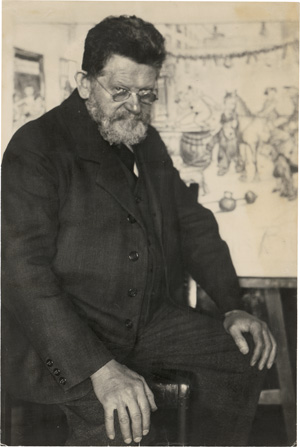
Portrait of the artist Heinrich Zille (1858-1929). 1922. Vintage large-format gelatin silver print. 59 x 39 cm. Photographer's stamp on the verso. Hinge-mounted along the upper edge in a mat.
This unusually large print, possibly intended for exhibition, brings together two prominent figures of German art: the photographer Hugo Erfurth and the artist Heinrich Zille. Both were renowned for their perceptive depictions of people. Zille was particularly known for his drawings of working-class life in Berlin, capturing the social realities and hardships of the city's tenement districts. Erfurth, meanwhile, established himself as one of Germany's leading portrait photographers, celebrated for his expressive portraits of artists, intellectuals and cultural figures, often employing the bromoil process.
Literatur: Bodo von Dewitz and Karin Schuller-Procopovici, eds. Hugo Erfurth 1874-1948. Photograph zwischen Tradition und Moderne. Cologne: Wienand, 1992, ill. p. (bromoil print).
Erfurth, Hugo
The art critic and historian Will Grohman
Los 4134
Schätzung
900€ (US$ 1,034)
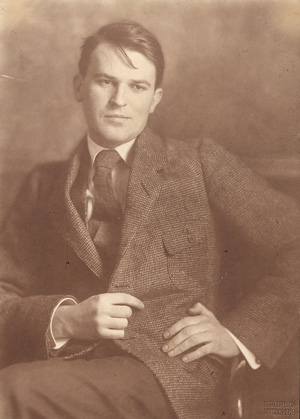
The art critic and historian Will Grohmann (1887-1968). Circa 1919. Vintage sepia-toned matte gelatin silver print, mounted to black paper and subsequently to brown paper. 22,3 x 16,3 cm. Photographer's blindstamp in the lower right corner.
Will Grohmann was a prominent German art critic and historian who played a significant role in promoting modern and abstract art in 20th-century Europe. Often referred to as the "godfather of modernism", he championed avant-garde movements and maintained close relationships with numerous leading artists of his time. He published important monographs on artists such as Ernst Ludwig Kirchner, Wassily Kandinsky, Paul Klee and Willi Baumeister, contributing significantly to the critical reception and recognition of modern art.
Literatur: Bodo von Dewitz and Karin Schuller-Procopovici, eds. Hugo Erfurth 1874-1948. Photograph zwischen Tradition und Moderne. Cologne: Wienand, 1992, ill. p. 339 (bromoil print).
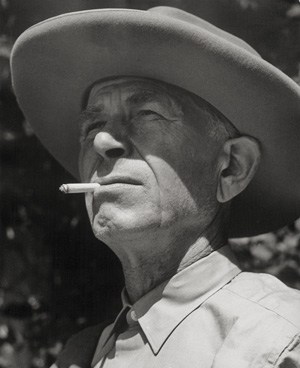
Otto Dix. 1950. Vintage gelatin silver print on Agfa-Brovira paper. 29,3 x 23,8 cm. Photographer's/copyright "Berlin-Wilmersdorf, Kaiser-Platz 1" stamp and number stamp on the verso.
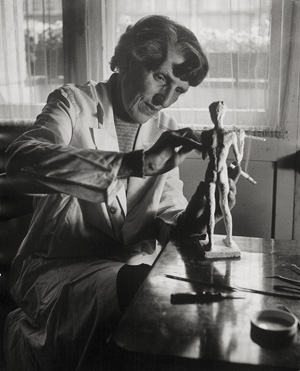
Primarily known for his portrait photography, Fritz Eschen photographed a wide range of prominent figures, including industrialists, artists, politicians, actors, writers and scientists. Rather than relying on conventional studio settings, he frequently portrayed his subjects in their familiar surroundings - at work, in their studios or offices, or at home. His approach emphasised the relationship between individuals and their environments, resulting in intimate, often informal portraits that reveal both the character of his sitters and their professional and personal lives.
Eschen, Fritz
Renée Sintenis modelling her sculpture "Knabe mit Querflöte"
Los 4136
Schätzung
600€ (US$ 690)
Renée Sintenis modelling her sculpture Knabe mit Querflöte. 1952. Vintage gelatin silver print on Agfa-Brovira paper. 29,3 x 23,8 cm. Photographer's/copyright "Berlin-Wilmersdorf, Kaiser-Platz 1" stamp, number stamp and annotated in ink/pencil on the verso.
Evans, Walker
Untitled (Tenant farmer's daughter, Hale County, Alabama)
Los 4137
Schätzung
1.200€ (US$ 1,379)
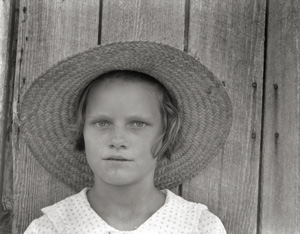
Untitled (Tenant farmer's daughter, Hale County, Alabama). 1936. Large-format, matte gelatin silver print, printed 1970s by the Library of Congress from the original negative. 28 x 35 cm. "Reproduced from the collection of the Library of Congress" stamp and number notations in pencil on the verso. Taped to linen window front mat.
Walker Evans’ work for the Farm Security Administration (FSA) was instrumental in shaping the visual record of rural America during the Great Depression. His photographs captured the stark realities faced by individuals and communities, portraying economic hardship and social dislocation with clarity and empathy. Working alongside other FSA photographers, Evans helped create a lasting documentary of the era - one that not only deepened public awareness but also helped define documentary photography as a powerful vehicle for social insight and historical preservation.
Literatur: John T. Hill. Walker Evans: Lyric Documentary. Göttingen: Steidl, 2006, ill. p. 176.
John T. Hill and Gilles Mora. Walker Evans: Der unstillbare Blick. Munich: Schirmer/Mosel, ill. p. 204.
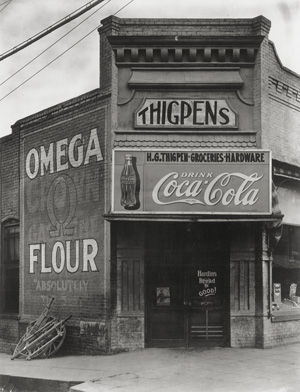
Corner Store, Marion, Alabama. 1936. Gelatin silver print, printed later from the original negative. Ca. 24,7 x 18,9 cm (sheet 35,6 x 27,5 cm). Estate stamp, Library of Congress archive number and annotated, titled and dated in pencil on the verso.
A variant print of this image titled Thigpens Groceries and Hardware Store, Marion, Alabama is in the collection of The Metropolitan Museum of Art, New York.
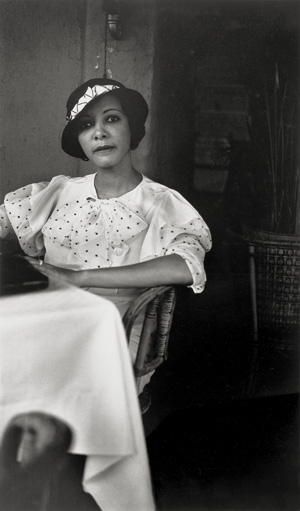
Senorita at a Café, Havana. 1933. Gelatin silver print, printed 1988 from the original negative by Brian Graham. 28 x 16,5 cm (sheet 35,5 x 27,7 cm). Annotated in pencil by another hand, as well as with “Walker Evans - Gelatin silver print from the original negative” stamp and authentication label on the verso.
Feininger, Andreas
Portrait of Lyonel Feininger, Dessau
Los 4140
Schätzung
2.000€ (US$ 2,299)
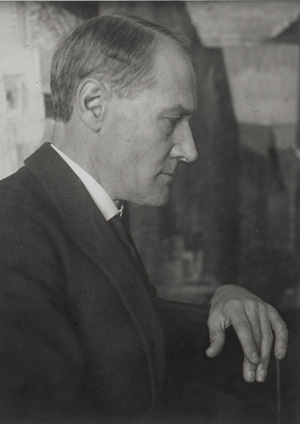
Portrait of Lyonel Feininger, Dessau. 1928. Vintage gelatin silver print, mounted along upper edge to original card. 22,2 x 16 cm (mount 29,8 x 21 cm). "Feiningerfoto" stamp and annotated in pencil on the verso; signed and annotated "Photo Andreas Feininger 1928" by Lyonel Feiniger in ink on mount verso
Andreas Feininger began studying at the Bauhaus in 1922, completing his training in the carpentry workshop in 1925. He subsequently studied architecture in Weimar and Zerbst, while developing an interest in photography during his time in Dessau, encouraged by his neighbor and Bauhaus teacher László Moholy-Nagy. In 1936, he moved to Sweden, where he devoted himself to photography professionally. He emigrated to the United States in 1939 and joined the staff of Life magazine in 1943, remaining there until 1962. The present portrait depicts his father, the painter and Bauhaus master Lyonel Feininger, during his time in Dessau.
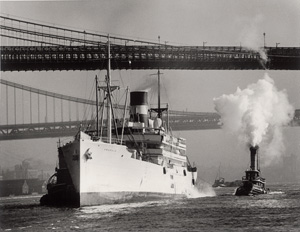
Ships on the East River, New York. 1940. Gelatin silver print, printed from the original negative 2010. 30,8 x 39,7 cm (sheet 40 x 50 cm). Griffelkunst edition stamp on the verso.
Literatur: Andreas Feininger. New York in the Forties. New York: Dover 1978.
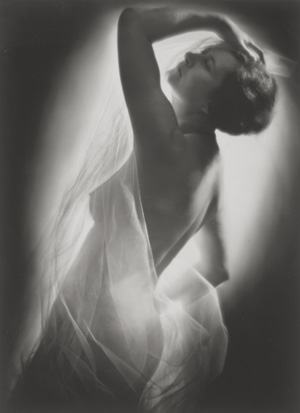
Female nude study; Fashion photo. Circa 1925. 2 vintage gelatin silver prints, 1 ferrotyped. Each circa 22 x 16 cm. 1 with photographer`s blind stamp in the lower right corner; each annotated in pencil on the verso.
Pepa Feldscharek graduated from the Graphische Lehr- und Versuchsanstalt in Vienna in 1918 and co-founded a photographic studio with fellow graduate Melanie Heller in 1920. From 1922 onwards, she ran the studio independently, specialising in fashion, dance and portrait photography. Her work appeared regularly in leading illustrated magazines, including Die Bühne, Moderne Welt, Die Dame, Berliner Illustrirte Zeitung, Wiener Magazin and Münchner Illustrierte Presse. Following the annexation of Austria in 1938, she fled Nazi persecution due to her Jewish heritage and emigrated to the United States, adopting the name Josefine Schreier. She eventually settled in Gloucester, Massachusetts, where she died in 1962.
Film Photography
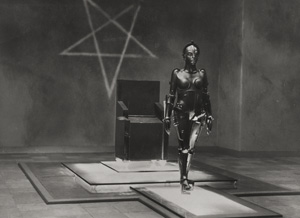
Brigitte Helm as the Maschinenmensch in the film 'Metropolis'
Los 4143
Schätzung
900€ (US$ 1,034)
Brigitte Helm as the "Maschinenmensch" in the film Metropolis. 1926. Vintage ferrotyped gelatin silver print. 12 x 16,5 cm. Annotated in ink and pencil, "Historia-Photo" agency stamp and layout marks in pencil on the verso.
Fritz Lang's Metropolis, released in 1927, was a commercial disappointment despite an elaborate publicity campaign, which included painting the façade of the Ufa-Pavillon at Nollendorfplatz in Berlin silver for the film's screening. Nevertheless, its groundbreaking special effects and futuristic visual design established it as a landmark of cinema history. The present photograph depicts Brigitte Helm as the "Maschinenmensch" (Machine-Man), a robot created in the likeness of Maria, the workers' leader, whom Helm also portrayed. The robot's distinctive appearance became one of the film's most recognizable images and featured prominently in its promotional material.
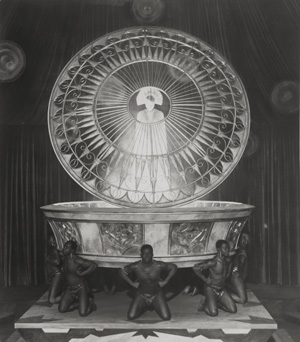
Scene from the film Metropolis. 1926. Vintage ferrotyped gelatin silver print. 20 x 18 cm.
[*]: Regelbesteuert gemäß Auktionsbedingungen. [^]: Ausgleich von Einfuhr-Umsatzsteuer.
* Alle Angaben inkl. 25% Regelaufgeld ohne MwSt. und ohne Gewähr – Irrtum vorbehalten.
Galerie Bassenge
Erdener Str. 5A
14193 Berlin
Öffnungszeiten:
Montag bis Donnerstag, 10–18 Uhr,
Freitag, 10–16 Uhr
Telefon: +49 30 8938029-0
Fax: +49 30 8918025
E-Mail: info (at) bassenge.com
Impressum
Datenschutzerklärung
© 2026 Galerie Gerda Bassenge
Galerie Bassenge
Erdener Str. 5A
14193 Berlin
Öffnungszeiten:
Montag bis Donnerstag, 10–18 Uhr,
Freitag, 10–16 Uhr
Telefon: +49 30 8938029-0
Fax: +49 30 8918025
E-Mail: info (at) bassenge.com
Impressum
Datenschutzerklärung
© 2026 Galerie Gerda Bassenge