
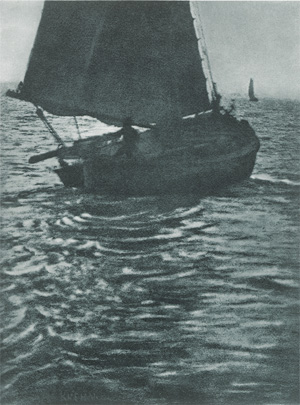
Kunst in der Photographie, Die
Die Kunst in der Photographie
Los 4061
Schätzung
3.000€ (US$ 3,448)
Die Kunst in der Photographie. 1897/98. 10 issues (of 12) with 51 photogravures.(of 60) on plates with photographer's name, printer's name and title. Various sizes between circa 20 x 14 cm or reverse (39 x 27 cm). Presented in loose portfolios in linen portfolio with title and illustration on front cover. Vol. I 1897 and issue Vol. II, issues1-4 1898, Berlin, Julius Becker.
The magazine Die Kunst in der Photographie was published in Berlin by Julius Becker from 1897-1899, then by Martin Oldenbourg. In 1901 Wilhelm Knapp’s publishing house in Halle an der Saale continued it with initially 66 issues. The magazine was distributed as individual issues in a folder designed by Hermann Hirzel. In 1908 publication ceased.
The magazine’s editor, Franz Goerke, an amateur photographer, was a founding member of the “Freie photographische Vereinigung” (Free Photographic Association) in Berlin. In 1896, the association decided to create a journal to showcase photographic developments from around the world, intending to gain recognition for photography as an art form.
In 1897, the first issue of Die Kunst in der Photographie was published. In addition to reproductions of works by renowned photographic pioneers, such as Alfred Stieglitz, Sarah Choate Sears, Rudolf Eickmeyer Jr., amateur photographers’ works were published as large-format photogravures or autotypes. The emphasis was on the Pictorialists’ work and their aesthetic merit. As the first photographic journal in the world, it treated art photography as an international movement. Franz Goerke was a main author among the various renowned contributors. The magazine’s sophisticated and insightful articles covering international photographers, photographic clubs and associations as well as exhibitions, declined sharply as of 1901.
Die Kunst in der Photographie contributed decisively to the dissemination of photographic images and the development of photography in the Western world. It strongly influenced subsequent publications, such as Camera Work, edited by Alfred Stieglitz. Unfortunately, this important journal is an underappreciated historical document that still awaits detailed research. Hardly any institutional German library owns it in its entirety.
Photogravure plates of works by the following photographers are included in the 2 volumes offered here: Craig Annan, Robert Demachy, Hugo Henneberg, Theodor and Oskar Hofmeister, Heinrich Kühn, Leonard Misonne, Alfred Stieglitz, Frank M. Sutcliffe and Hans Watzek.
Literatur: Rolf Krauss, "Die Kunst in der Photographie, the German Camera Work", in: History of Photography 10, no. 4: pp.265-297 (1986) & 11, no. 1: pp. 1-12 (1987).
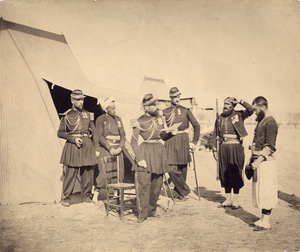
Le Gray, Gustave
Les Zouaves de la Garde impériale, Camp de Châlons
Los 4062
Schätzung
1.200€ (US$ 1,379)
Les Zouaves de la Garde impériale, Camp de Châlons. 1857. Albumen print from a glass negative. 29 x 34,3 cm. Annotated in pencil on the verso.
Commissioned by Napoleon III to document the Camp de Châlons, Le Gray’s 1857 series combined panoramic views and military maneuvres with carefully composed scenes of camp life. Officers and Zouaves of the Imperial Guard gather outside a tent to receive instructions, and their varied poses lendi the official subject the immediacy of a genre scene. The photographs were issued in presentation albums, which the Emperor gave to high-ranking officers.
Literatur: Sylvie Aubenas. Gustave Le Gray, 1820-1884. Los Angeles: Getty Publications, 2002. ill. pl. 160, p. 136, pl. 259, p. 224 and pl. 144 and 145, p. 368 (images from the same series).
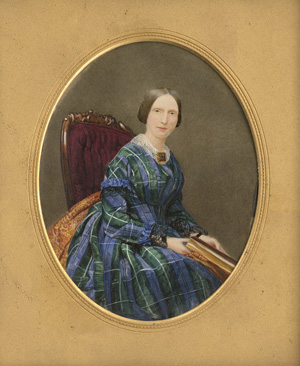
Portrait of a woman. Ca. 1853-54. Hand-colored salted paper print, mounted behind a metal oval window mat in a contemporary leather case with velvet lining. 14 x 11 cm. Gilt-stamped on front cover: “Lock. Photographic Artists, 100 Quadrant, Regent St.”
In the early 1850s, Samuel Lock worked as a miniature painter, transforming talbotype portraits into colored likenesses. In September 1856, he joined George Whitfield, who had recently opened a photographic portrait studio in London’s Regent Street, to form Lock & Whitfield. The especially fine hand-coloring of the present portrait demonstrates Lock’s skill in combining photography with miniature painting.
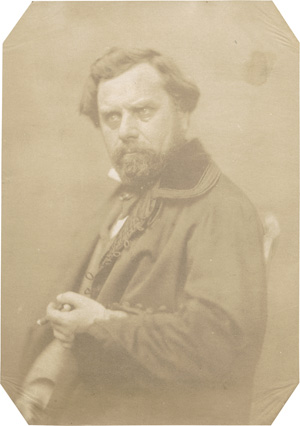
Portraits of Munich artists: August Klotz, Johann Jakob Eberhardt, Heinrich Kohler and Joseph Bernhardt. 1848-1849. 4 salted-paper prints from calotype negatives, mounted on grey card with double ruled pencil borders. Each between 17,5 x 14,2 cm and 24 x 19,5 cm (mounts 35 x 29 cm). With pencil identifications and biographical dates on versos, including "Maler Klotz / August (1808-1853)", "Maler Eberhard / Johann Jakob Eberhardt (1820-1889)", "Heinrich Kohler (1808-1885)" and "Maler Bernhard / Joseph (1805-1885)".
This group belongs to Löcherer’s remarkably early series of portraits of artists working in Munich, made in his studio before 1850. August Klotz was a history painter and conservator of the Munich Kunstverein and royal collections; Johann Jakob Eberhardt combined art-historical writing with genre painting; Heinrich Kohler was a painter and lithographer; and Joseph Bernhardt was a portrait painter who had trained in Paris under Paul Delaroche, before establishing a painting school in Munich.
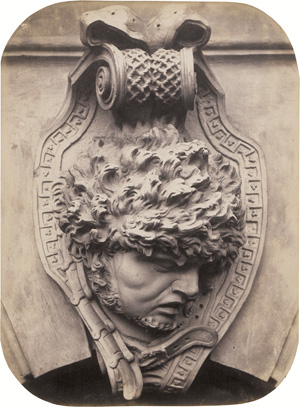
Lutze, Gustav & Carlos Witte
Masks of dying warriors by A. Schlüter
Los 4065
Schätzung
600€ (US$ 690)
Masks of Dying Warriors by Andreas Schlüter (1659-1714), Berlin Zeughaus. Ca. 1857. 3 coated salted paper prints, mounted to original boards. Each ca. 28,6 x 21,1 cm (mounts ca. 36 x 26,9 cm). All boards stamped: "Atelier für Architectur, Fr. Schwechten, Königl. Baurath, W., Lützowstr. 68"; typographically inscribed: "Nach dem Original von Schlüter, photographiert von Lutze & Witte. In Commission bei L. Hasse & Co. in Berlin, Leipziger Str. No. 71, 1 Tr."; each numbered by hand.
The Schlüterköpfe comprise 22 high-relief heads of dying warriors, designed by Andreas Schlüter, executed for the inner courtyard of Berlin’s Zeughaus in 1696-97. Set as keystones above the ground-floor arched windows, the masks form a powerful counterpoint to the martial trophies on the building’s exterior. Rather than relying on conventional grotesque types, Schlüter gave the heads a strikingly individual, expressive character. This rare early photographic record, made by the court photographers Lutze & Witte, preserves three of the celebrated Baroque sculptures in impressive detail.
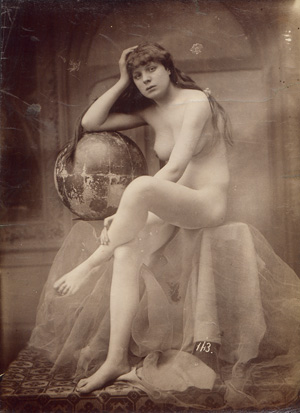
Academic nude with globe. 1870s. Albumen print. 26,6 x 19,3 cm. Numbered "143." in the negative lower right; faint blue pencil annotation on the verso.
Gaudenzio Marconi specialized in academic nude studies, produced in Paris and later Brussels for painters and sculptors. His photographs translate the conventions of life drawing into carefully staged studio compositions, using drapery, props and classical references to lend the figure an allegorical character. The present work belongs to this intersection of academic instruction and nineteenth-century studio photography.
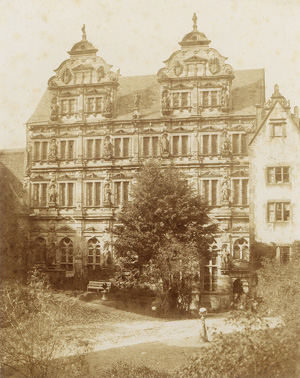
Marville, Charles
Façade du palais de Frédéric le Sage, château d’Heidelberg.
Los 4067
Schätzung
1.000€ (US$ 1,149)
Façade du palais de Frédéric le Sage, château d’Heidelberg. 1852. Salted-paper print from a paper negative, printed 1853, mounted to card. 27,2 x 21,5 cm (mount 35,8 x 29,7 cm).
Plate 23 from Les Bords du Rhin, published by Louis-Désiré Blanquart-Evrard in Lille. The series belongs to Marville’s formative period, when the publisher’s albums gave him an early platform for architectural and landscape photography beyond France. Made before his official work for the City of Paris, the Heidelberg photographs establish concerns that remained central to his career: the exact recording of historic fabric, the translation of architecture into a coherent photographic composition, and the use of the medium to make monuments available to a broad audience.
Literatur: Charles Marville. Les Bords du Rhin. Lille: Blanquart-Évrard, 1853-54, pl. 23;
Milan Chlumsky, ed. Das Heidelberger Schloß in der Fotografie vor 1900. Heidelberg: Edition Braus, 1990, ill. p. 24.
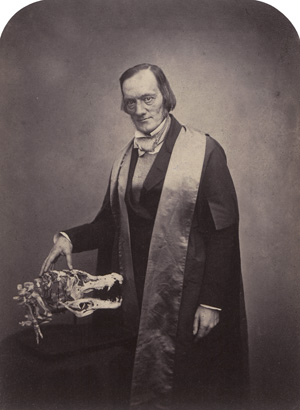
Portraits of British public figures. Circa 1857-1864. 4 Woodburytypes, mounted to card with printed gilt border. Each 20 x 14,8 cm (26,5 x 21,6 cm). Titled in pencil or ink by hand on the mount below the image; photographer’s credit printed on the mount: “Photographed by Maull & Polyblank, 55, Gracechurch Street and 187a, Piccadilly, London.”
This group of early photographic portraits by the London studio Maull & Polyblank features prominent figures of mid-Victorian public life. Among them are Sir Richard Owen, the pioneering comparative anatomist and founder of the Natural History Museum in London, shown with a fossil specimen; Sir William Sterndale Bennett, influential composer and Principal of the Royal Academy of Music; Lord Stanley, later the 15th Earl of Derby and a three-time British Foreign Secretary; and Charles Kean, celebrated Shakespearean actor and theater manager. Taken between 1857-1864, these portraits exemplify the studio’s ambition to create a visual pantheon of British cultural and political leadership.
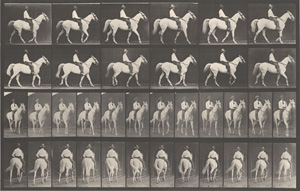
Elberon, Walking, Saddled. 1884-85. Collotype, printed 1887. Plate 579 from Animal Locomotion: An Electro-Photographic Investigation of Consecutive Phases of Animal Movements. 22 x 34,5 cm (sheet 48,5 x 61 cm). Printed below image with copyright notice, title and plate number.
Muybridge first achieved international renown through his 1878 sequential photographs of a galloping horse, which demonstrated that all four hooves leave the ground during part of the stride. Under the auspices of the University of Pennsylvania, he expanded these investigations in 1884-85 to encompass human and animal movement. Published in 1887, Animal Locomotion comprised 781 collotype plates and offered an unprecedented analysis of successive phases of motion, with a lasting influence on both scientific study and the visual arts. Another impression is in the collection of the National Gallery of Art, Washington, D.C.
Muybridge, Eadweard
Movements, Female, Toilet; preparing to put on clothing
Los 4070
Schätzung
600€ (US$ 690)
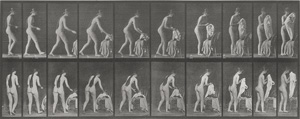
Movements, Female, Toilet; Preparing to Put on Clothing. 1884-85. Collotype, printed 1887. Plate 415 from Animal Locomotion, vol. IV, Women (Nude). 17 x 43 cm (sheet 35 x 49,5 cm). Printed below image with copyright notice, title and plate number.
Part of the Women (Nude) section of Animal Locomotion, this plate records an everyday action through a sequence of timed exposures. Its measured progression transforms a conventional figure study into a precise analysis of bodily movement, demonstrating the productive tension between Muybridge’s scientific method and the work’s lasting visual force. Another impression is in the collection of the Pennsylvania Academy of the Fine Arts, Philadelphia.
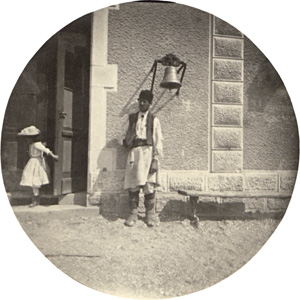
Views of Turkestan. 1890. 15 gelatin silver prints from flexible Kodak negatives. Each ca. 16,2 x 12,4 cm or reverse (circular images ca. 8,8 cm diameter). Some annotated in pencil on the versos; a few numbered in the negative in the lower margin.
In 1890, Paul Nadar travelled through the Caucasus and Turkestan via the military Transcaspian Railway to Samarkand and Tashkent, in connection with the Tashkent Exhibition. Alongside his large-format work, he used Kodak flexible film and the Express Détective Nadar camera to make rapid, circular-format photographs. The present group includes camel caravans, road and waterside scenes, local markets, portraits and groups, religious architecture, and scenes of daily life. Returning to Paris, Nadar announced 1,800 photographs from the journey and promoted the work in lectures, publications and international exhibitions through 1896.
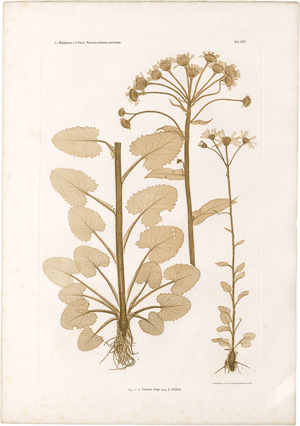
Photographers: Constantin von Ettingshausen (1826-1897) and Alois Pokorny (1826-1886). Plant studies from Physiotypia plantarum austriacarum: Der Naturselbstdruck in seiner Anwendung auf die Gefässpflanzen des österreichischen Kaiserstaates, mit besonderer Berücksichtigung der Nervation in den Flächenorganen der Pflanzen, Vienna, K.K. Hof- und Staatsdruckerei. 1855-1856. 6 nature prints (Naturselbstdrucke) on heavy paper. Each ca. 58 x 41 cm. With printed series title, plate numbers 62, 217, 227, 255, 420 and 471, Latin plant identifications and printer’s imprint.
A representative group from Ettingshausen and Pokorny’s celebrated botanical publication. Using the nature-printing process, actual specimens were transferred with exceptional precision, preserving the plants’ forms and fine venation. The selection includes grasses and flowering plants, among them Lamarckia aurea, Alyssum montanum, Epilobium roseum and Rumex obtusifolius.
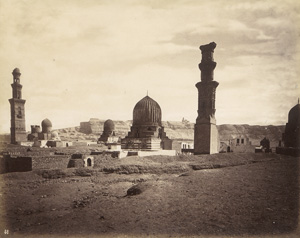
Naya & Schoefft
Vue générale des tombeaux des Mameluks, Cairo
Los 4073
Schätzung
600€ (US$ 690)
Vue générale des tombeaux des Mameluks, Cairo, from “Le Caire pittoresque.” Ca. 1875. Albumen print, mounted to blue-gray card. Image: 19,8 x 25 cm (mount 22,5 x 27,8 cm). Number “88” in the negative at lower left.
Naya’s Venetian publishing enterprise and Schoefft’s Cairo studio joined forces in the mid-1870s to produce Le Caire pittoresque, a series of architectural views, landscapes and genre scenes made for the European market. This view of the Mamluk necropolis is from the series’ extensive survey of Cairo and its environs, combining Schoefft’s local photographic practice with Naya’s established international distribution network.
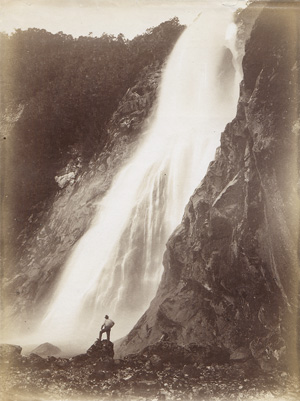
New Zealand
Views of mountain ranges, waterfalls and lakes in New Zealand
Los 4074
Schätzung
900€ (US$ 1,034)
Photographer: Burton Bros. (1866-1914). Views of mountain ranges, waterfalls and lakes in New Zealand. Circa 1885. 19 albumen prints. Each circa 15 x 20 cm and reverse. Some with number in the negative in lower corners; most with photographer's stamp and annotated in pencil on the verso.
The Burton Brothers studio was among the leading photographic businesses of nineteenth-century New Zealand. Walter John Burton (1836-1880) established the Grand Photographic Saloon and Gallery in Princes Street, Dunedin, in 1866; with the arrival of his brother Alfred Henry Burton (1834-1914) in 1868, the business became Burton Brothers. During their partnership, which ended in 1877, Walter directed the Dunedin portrait studio while Alfred travelled widely to produce landscapes and panoramic views; their travelling dark-van, built for wet-plate work, enabled photography in remote terrain as well as the safe transport of the studio’s equipment. The firm supplied settlers with portraits and marketed its views of the colony, including Māori portraiture, to local and international audiences in individual prints, series and albums. The present selection surveys the dramatic landscapes of the South Island, including Bowen Falls, Mitre Peak, Franz Josef Glacier, Hot Water Basin, the Matukituki River, Mount Cook, Diamond Lake, Mount Rolleston, Lake Manapouri, Otira Gorge, Arthur River, Lake Ada, Milford Sound and “The Lion” at Milford Sound.
Provenienz: By descent to the current owner.
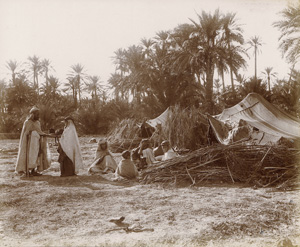
Photographers: Albert Clapier (active 1886-1890), Neurdein Frères (active 1863-1918), and others. Views of Tunisia and Algeria. 1880s-1890s. 38 collodion prints, mounted recto and verso to grey-brown album leaves. Each between 11 x 14,5 cm and 23 x 28,5 cm (mounts 26,5 x 32,5 cm). Several prints numbered, titled and credited in the negative “ALBERT, Ph. — Tunis”, “Albert Phot.” or “ND Phot.”. Bound in a contemporary brown textured cloth album with gilt-stamped title “Tunesien & Algeriet” and patterned endpapers (overall size: 28 x 36,5 x 6 cm).
A richly varied commercial travel album spanning Tunisia and Algeria. Alongside views of Tunis, the Mosque of Sidi Mahrez, the Bardo, Carthage and Gabès, it includes oasis and desert landscapes, architectural studies, markets and encampments, as well as studio portraits and scenes of daily life. Beigegeben: 8 loose albumen prints of Egyptian monuments and everyday life, including views of Philae, Karnak, Kom Ombo, Abu Simbel and the Colossi of Memnon.
[*]: Regelbesteuert gemäß Auktionsbedingungen. [^]: Ausgleich von Einfuhr-Umsatzsteuer.
* Alle Angaben inkl. 25% Regelaufgeld ohne MwSt. und ohne Gewähr – Irrtum vorbehalten.
Galerie Bassenge
Erdener Str. 5A
14193 Berlin
Öffnungszeiten:
Montag bis Donnerstag, 10–18 Uhr,
Freitag, 10–16 Uhr
Telefon: +49 30 8938029-0
Fax: +49 30 8918025
E-Mail: info (at) bassenge.com
Impressum
Datenschutzerklärung
© 2026 Galerie Gerda Bassenge
Galerie Bassenge
Erdener Str. 5A
14193 Berlin
Öffnungszeiten:
Montag bis Donnerstag, 10–18 Uhr,
Freitag, 10–16 Uhr
Telefon: +49 30 8938029-0
Fax: +49 30 8918025
E-Mail: info (at) bassenge.com
Impressum
Datenschutzerklärung
© 2026 Galerie Gerda Bassenge