
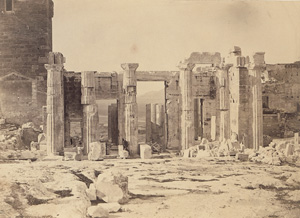
Photographer unknown. Selected views of the Acropolis. Circa 1860s/70s. 6 albumen prints, mounted to board. Each between ca. 15 x 21 cm and 21 x 26,5 cm or reverse (mounts 32 x 44 cm or reverse).
The views include the Propylaea from the east, a general view of the Acropolis and the South Slope, the Parthenon, the Arch of Hadrian, the Erechtheion. An attractive group of views that give an early impression of the historic site.
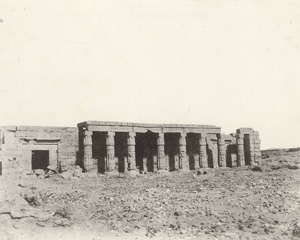
Thèbes, Temple de Gournah. 1854. Salted paper print from a waxed paper negative, mounted to board. 23,5 x 29,5 cm (mount 39,8 x 57 cm). Signed in the negative at lower right; titled in ink on the mount at lower left.
During his 1853-54 journey along the Nile, Greene made one of the earliest sustained photographic surveys of Egyptian antiquities. Working from waxed paper negatives, he produced views in which the open foreground and broad expanse of sky give the ruin an exceptional formal clarity. This view depicts the columned remains of the Temple of Gournah on the west bank of Thebes.
Greene, John Beasley
Nubie. Speos de Sebouah, Pylones
Los 4048
Schätzung
1.200€ (US$ 1,379)
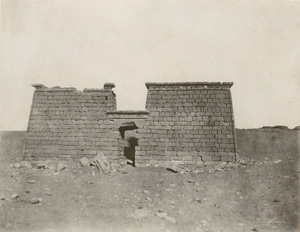
Nubie. Speos de Sebouah, Pylones.1853-1854. Salted paper print from a waxed paper negative, mounted to board. 23,2 x 30 cm (mount 39,8 x 55,8 cm). Signed and numbered "M. 7" in the negative in lower margin; titled in ink lower left on the mount.
This view records the pylon façade of the temple at Wadi es-Sebua, a Ramesside sanctuary dedicated to Amun-Ra and Ra-Horakhty. Its rigorous frontal composition and broad, unpopulated foreground exemplify Greene’s distinctly modern, archaeological approach to the Egyptian monument.
Hanfstaengl, Franz
Early views of Munich: Die Theatinerkirche und die Feldherrnhalle; Die neue Pinakothek; Das Siegesthor
Los 4049
Schätzung
1.200€ (US$ 1,379)
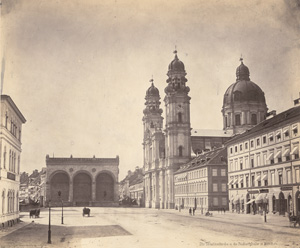
Early views of Munich: Die Theatinerkirche und die Feldherrnhalle; Die neue Pinakothek; Das Siegesthor . 1854. 3 large-format salted paper prints, each mounted to board. Each circa 31,5 x 38,3 cm. Each with title in the negative in lower corners, collection stamp, photographer's name printed and ornamental hand-painted title below the image on the mount.
These early views of Munich, taken in 1854, testify to Franz Hanfstaengl’s rapid adoption of the wet-collodion process. Frederick Scott Archer had published the process in March 1851 and exhibited examples at London’s Great Exhibition later that year. As one of its early German practitioners, Hanfstaengl exploited the new medium’s exceptional descriptive clarity as did many other international photographers.
Provenienz: Simon Moritz von Bethmann (1811-1877), Ludwig Simon Moritz von Bethmann (1844-1902) Collection
Literatur: Heinz Gebhardt. Franz Hanfstaengl. Von der Lithographie zur Photographie. Munich: C.H. Beck, 1984, ill. p. 136.
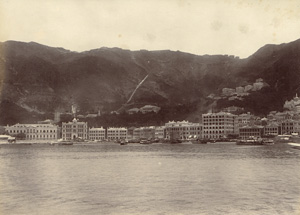
Photographers: Lai Afong (ca. 1839-1890), Pun Lun Studio (active ca. 1864-1907), and unknown. Views of Hong Kong. 1880s. 11 albumen prints. Each between 19,5 x 25,5 cm and 21,5 x 27,5 cm. Some annotated in pencil on the verso.
This group of photographs captures main sites of colonial-era Hong Kong in the late 19th century, including Victoria Harbour, Queen’s Road Central, St. John’s Cathedral, the Zoological and Botanical Gardens, as well as the iconic stone steps of Pottinger Street with sedan chair and rickshaw bearers.
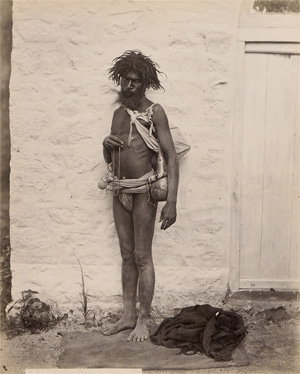
Photographer: Samuel Bourne (1834-1912), Edward Taurines (active 1885-1902), Shepherd & Robertson, Skeen & Co. and unknown. Views and types of India and Ceylon. 1870s-1890s. 27 albumen prints, mounted to board. Each ca. 22 x 29 cm (mounts 32 x 39,5 cm) and reverse. Some signed and numbered in the negative in lower corners.
This group of photographs comprises a selection of atmospheric views of India and Ceylon as well as interesting depictions of people of those countries.
Literatur: Ludger Derenthal, Raffael Dedo Gadebusch, Katrin Specht, eds. Das koloniale Auge. Frühe Porträtfotografie in Indien. Leipzig: Koehler & Amelang, 2012, ill. pp. 126, 128, 150 and 154.
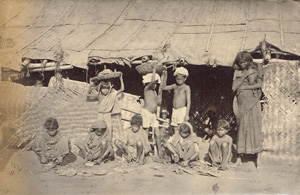
Photographer: Willoughby Wallace Hooper (1837-1912). Famine victims, Madras. 1876-1878. 5 albumen prints. Each 10 x 15,5 cm. Each with photographer's monogram and number in lower left corner in the negative.
A British army officer stationed in India, Willoughby Wallace Hooper also contributed photographs to the colonial survey The People of India (1868-75). His famine photographs are a powerful yet ethically complex record of the Great Famine of 1876-78, that affected large areas of southern and central India and caused more than 5,5 million deaths.
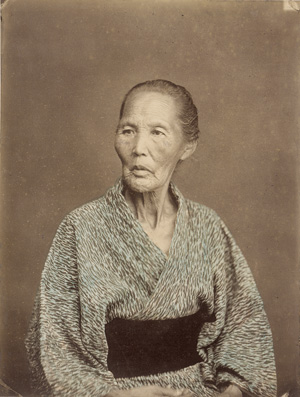
Photographer: Baron Raimund von Stillfried-Ratenicz (1837-1916). Japanese costume and genre studies. 1870s. 4 hand-colored albumen prints, mounted to card. Ca. 26,5 x 20,5 cm (mounts ca. 60,5 x 47,5 cm), or reverse. Later pencil annotations and inventory labels on versos.
These four prints are characteristic examples of Stillfried’s “costumes”: a modular stock of hand-colored genre subjects devised for the high-end Yokohama album trade. Developed during the first years of his independent practice, this repertoire combined repeatable compositions from glass negatives with painstaking hand-coloring by specialist studio staff, giving commercially issued photographs the finish and visual authority of singular objects. One print in this lot, Lady Writing, appears in Views and Costumes of Japan (ca. 1876), whose frontispiece explicitly distinguishes Stillfried as maker of the negatives from Stillfried & Andersen as printer and publisher.
Literatur: Hugh Cortazzi and Terry Bennett. Japan: Caught in Time. Reading: Garnet Publishing, 1994, ill. pp. 97, 105, and 108 (same studio backdrop on pp. 97 and 105).
Japan
Japan: Yokohama, Tokyo, Kamakura, Nikko, Kobe and environs
Los 4054
Schätzung
1.200€ (US$ 1,379)
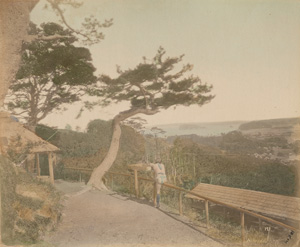
Photographer: Usui Shūsaburō Studio (active ca. 1875-1894). Views of Japan: Yokohama, Tokyo, Kamakura, Nikko, Kobe and environs. 1880s. 48 hand-colored albumen prints, mounted to album leaves. Each ca. 20,8 x 25,2 cm or reverse (album pages 27,8 x 34,4 cm). Numbered and captioned in the negatives. Bound in contemporary black-lacquered boards with gilt and polychrome decoration; gilt page edges (overall size 29 x 37 x 4 cm).
The album traces a scenic itinerary from Yokohama through Tokyo and Kamakura to Nikko, before continuing to Kobe and the Osaka railway. It brings together panoramas, urban streets, temple and shrine complexes, Buddhist monuments, gardens, waterfalls, lakeside views and mountain settlements, with occasional figures animating the sequence. The selection moves deliberately between the treaty-port city, the capital, pilgrimage sites and celebrated resort landscapes, offering a comprehensive late-nineteenth-century image of Japan for the foreign traveller.
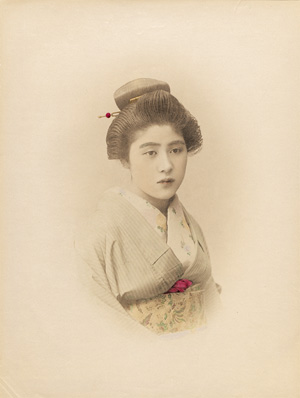
Photographers: Esaki Reiji (1845-1910), Shin-e-do, Kobe (active ca. 1894-1901). Japanese genre scenes and portraits. 1890s. 5 hand-colored albumen prints. Each ca. 26,2 x 20,4 cm or reverse. One with oval violet distributor’s stamp on verso: “PHOTOGRAPH DEPOT / SHIN-E-DO / KOBE JAPAN”; two captioned and numbered in the negatives: “1609 PLAYING GO” and “1517 GIRLS PLAYING KOTO AND SAMISEN”; one further print numbered “263”.
A cohesive group of Meiji-period export photographs, depicting women in kimono in a formal portrait and in carefully composed scenes of music, tea drinking and Go. The hand-coloring is remarkably delicate, reserving subtle accents for textiles, hair ornaments, furnishings and painted screens while preserving the soft tonal modelling of the albumen prints. Such photographs were made for the international souvenir market, presenting Japanese dress, domestic interiors and cultivated pastimes in a composed, decorative visual language.
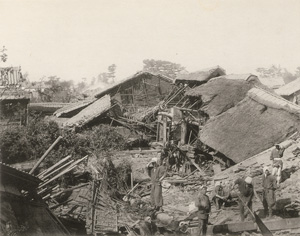
John Milne and W.K. Burton. The Great Earthquake in Japan 1891. Photographs principally by William Kinninmond Burton (1856-1899), with contributions by Kin Miyashita (active late 19th century), Saburō Aoyama (active late 19th century), Kusakabe Kimbei (1841-1934) and Bokuyō Nakamura (active late 19th century). 5 l., 10 p., 30 photomechanical plates by Ogawa Kazumasa (1860-1929), each with accompanying text page, and 1 map. Images each ca. 22,5 x 28,5 cm. Bound in original emerald-green cloth album with gilt-stamped title on front cover. Yokohama: Lane, Crawford & Co., ca. 1893.
This scarce second edition is an important early photographic record of the Mino–Owari, or Nōbi, earthquake of 28 October 1891. The most powerful inland earthquake recorded in modern Japan, it devastated the provinces of Mino and Owari, killing more than 7,000 people and destroying some 140,000 buildings. The plates document collapsed bridges, buckled railway lines, ruined factories and hospitals, temporary shelters and displaced inhabitants, tracing the disaster’s impact on both traditional settlements and the modernizing infrastructure of Meiji Japan.
Ogawa’s finely printed photomechanical plates convey the scale and human consequences of the destruction with exceptional immediacy. Accompanying texts give detailed accounts of the damage to life and property, while the final plate extends the volume’s comparative scope through six views of earthquake damage in Manila and Italy.
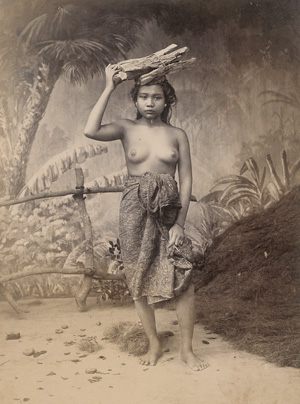
Photographer: Fedor Schulze (1836-1908) and unknown. People of Java and Singapore. 1880s-1890s. 18 albumen prints, mounted to board. Each ca. 26 x 19,5 cm (mounts 40,5 x 31,5 cm) and reverse.
A compelling group of studio portraits from Java and Singapore, combining strong individual presence with the rich decorative language of late nineteenth-century commercial photography. German-born former KNIL officer Fedor Schulze established his Batavia studio in the 1890s, where he marketed “types and views” alongside his travel publications; the present selection is characteristic of this flourishing visual culture.
Konstantinou, Dimitrios and Unknown
Selected views of the Acropolis
Los 4058
Schätzung
1.200€ (US$ 1,379)
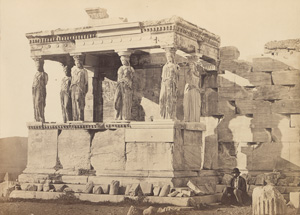
Selected views of the Acropolis. Circa 1865. 6 albumen prints, mounted to board. Each between ca. 28 x 39 cm and 21 x 26,5 cm or reverse (mounts 32,5 x 42 cm or reverse). 1 with photographer's name in the negative in lower left corner.
The group includes the Caryatid Porch and north portico of the Erechtheion, the west façade of the Parthenon and the Theatre of Dionysus, alongside close studies of sculptural detail, notably its honorary seats. Combining broad architectural views with more intimate observations, these photographs form an attractive early record of the Acropolis and its principal monuments.
Literatur: Dorothea Ritter. Im Lichte des Helios: Griechenland und frühe Photographien aus der Sammlung Siegert. Berlin: Umschau/Braus, 1999, ill. pp. 17, 80.
Claire L. Lyons, John K. Papadopoulos, Lindsey S. Stewart, and Andrew Szegedy-Maszak, eds. Antiquity & Photography: Early Views of Ancient Mediterranean Sites. London: Thames & Hudson, 2005, ill. p. 15.
Konstantinou, Dimitrios and Unknown
Sculptural fragments from the Acropolis
Los 4059
Schätzung
1.000€ (US$ 1,149)
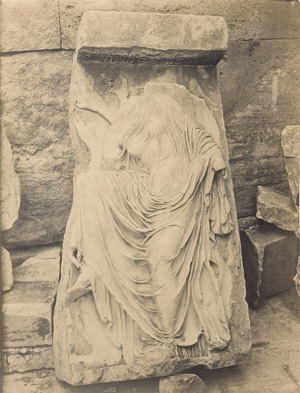
Sculptural and architectural fragments from the Acropolis. 1865-70s. 8 albumen prints, mounted to board. Each between ca. 27 x 20,5 cm and 21 x 26,5 cm (mounts 32 x 47 cm or reverse).
Among the sculptural and architectural fragments depicted are a Palmyrene female funerary bust; a statue of Papposilenos; the proscenium of the Theatre of Dionysus; the Atarbos Base; a relief of a dancing Maenad; and the celebrated parapet relief from the Temple of Athena Nike, Nike Adjusting Her Sandal.
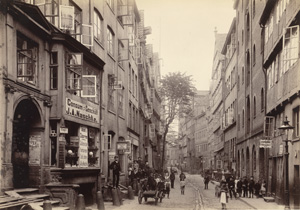
Views of Hamburg. 1881-84. 12 large-format albumen prints, mounted to board. Each ca. 23,5 x 31,7 cm (mounts ca. 32 x 40 cm). Each printed below the image: “Photographie von G. Koppmann & Co., Hamburg,” with a German title; dated in the print 1881, 1883 or 1884.
Georg Koppmann was one of Hamburg’s foremost documentary photographers and recorded the city’s transformation into a modern port on behalf of the municipal building authorities. This exceptional group concentrates on the old waterfront quarter around Bei den Mühren, Kannegiesserort and St Catherine’s Church: narrow streets, timber-framed houses, crowded quays and the Binnenhafen are observed with remarkable clarity. Made shortly before extensive demolition and redevelopment of the Speicherstadt, the views preserve a substantial section of old Hamburg that has since disappeared.
Literatur: Will Keller. Hamburg in frühen Photographien, 1848-1888: Sammlung Bokelberg. Hamburg: Verlag der Sammlung Bokelberg, 1980.
[*]: Regelbesteuert gemäß Auktionsbedingungen. [^]: Ausgleich von Einfuhr-Umsatzsteuer.
* Alle Angaben inkl. 25% Regelaufgeld ohne MwSt. und ohne Gewähr – Irrtum vorbehalten.
Galerie Bassenge
Erdener Str. 5A
14193 Berlin
Öffnungszeiten:
Montag bis Donnerstag, 10–18 Uhr,
Freitag, 10–16 Uhr
Telefon: +49 30 8938029-0
Fax: +49 30 8918025
E-Mail: info (at) bassenge.com
Impressum
Datenschutzerklärung
© 2026 Galerie Gerda Bassenge
Galerie Bassenge
Erdener Str. 5A
14193 Berlin
Öffnungszeiten:
Montag bis Donnerstag, 10–18 Uhr,
Freitag, 10–16 Uhr
Telefon: +49 30 8938029-0
Fax: +49 30 8918025
E-Mail: info (at) bassenge.com
Impressum
Datenschutzerklärung
© 2026 Galerie Gerda Bassenge