
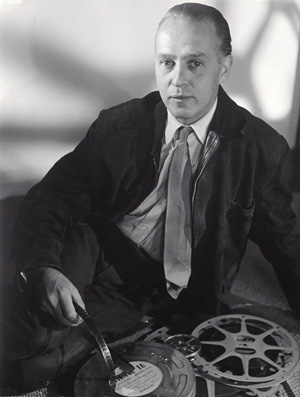
Henri, Florence
Portrait of the photographer Willy Maywald
Los 4175
Schätzung
400€ (US$ 460)
Portrait of the photographer Willy Maywald. 1953. Vintage large-format gelatin silver print. 39,8 x 30,2 cm. Photographer's stamp and annotated in pencil on the verso.
Florence Henri was a pioneering figure of avant-garde photography whose artistic approach was strongly influenced by her background in painting and her studies at the Bauhaus. Best known for her experimental compositions, innovative use of mirrors and striking portraits, she combined geometric abstraction with a distinctive sensitivity to light, form and perspective. The present large-format portrait depicts fellow photographer Willy Maywald, who established himself as one of the leading fashion and portrait photographers in post-war Paris, particularly through his work for Christian Dior.
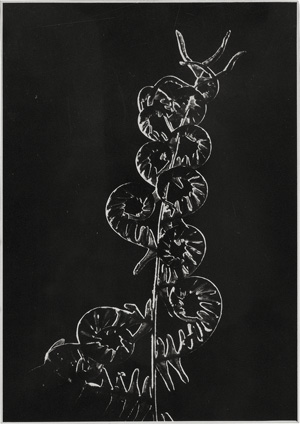
Plant studies. 1930s. 3 gelatin silver prints on carte postale, 1 on Afga paper, printed 1950s/60s. Each circa 14 x 10 cm. 1 with photographer's label and archive number in ink on the verso.
Little is known about the life and photographic work of Lena ("Lenchen") Holderer, who was born in Freiburg im Breisgau and settled in Karlsruhe in 1930. She is believed to have received her early photographic training from Carl Albiker, with whom she maintained a lifelong friendship and occasionally collaborated. Following World War II, her work received support from Martha Hoepffner, and she held a teaching position at the Technische Hochschule Karlsruhe from 1952 to 1956. Her photographs, particularly her studies of plants and natural forms, reflect an interest in abstraction and experimental composition.
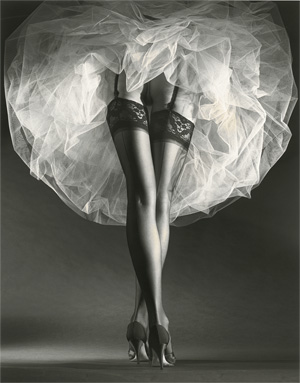
Round the Clock I, NY. 1987. Gelatin silver print, printed later. 45 x 35 cm (sheet 50,5 x 40,2 cm). Photographer's blindstamp in the lower margin; signed by the photographer in pencil and titled and dated in another hand in pencil on the verso.
Horst P. Horst was one of the most influential fashion photographers of the 20th century, renowned for his sophisticated compositions, dramatic lighting and sculptural treatment of the human form. Drawing inspiration from classical art and Surrealism, he developed a distinctive visual language that combined elegance with meticulous attention to form and detail. The present photograph belongs to a series commissioned by the American hosiery brand Round the Clock in 1987, exemplifying his ability to combine commercial fashion photography with a refined artistic aesthetic.
Literatur: Richard J. Tardiff and Lothar Schirmer, eds. Horst. Sixty Years of Photography. New York: Thames & Hudson 1995, ill. pl. 195.
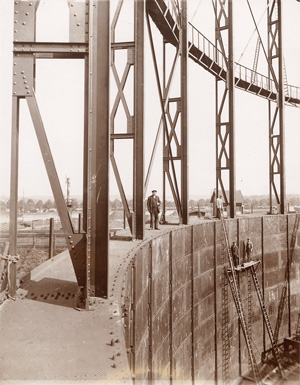
Photographer unknown. Construction of the Charlottenburg gasworks and its facilities. 1908-1911. 3 vintage collodion paper prints, 2 vintage gelatin silver prints. Each circa 29,5 x 24 cm or reverse.
The historic gasometer, once located at Gaußstraße 1 in Berlin-Charlottenburg, was originally constructed ca. 1911. It featured telescopic gas holders and later two large, 50-metre-high spherical high-pressure gas holders for the storage of natural and town gas. The plant was decommissioned in 1991, and the industrial structures were dismantled in the summer of 2006 as the site was redeveloped.
Literatur: Kathrin Baumstark, Andreas Hoffmann and Ulrich Pohlmann, eds. Moderne Zeiten. Industrie im Blick von Malerei und Fotografie. Hamburg: Bucerius Forum, 2021, ill. p. 99 (a view of the same structure).
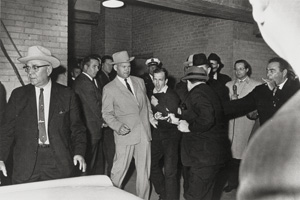
Jack Ruby Shooting Lee Harvey Oswald (for Dallas Times Herald). 1963. Gelatin silver press print on Kodak-RC paper, printed 1991. 20,2 x 25,3 cm. Printed press text and newspaper cutting with date stamp affixed to the verso.
Captured on November 24, 1963, by American press photographer Robert H. 'Bob' Jackson, this split-second exposure earned the 1964 Pulitzer Prize for Photography. By freezing the exact instant of Lee Harvey Oswald's assassination, Jackson’s photograph perfectly encapsulated the collective shock of the American public following the death of President John F. Kennedy. Today, it remains an unparalleled masterpiece of photojournalism and a defining visual marker of the 20th century.
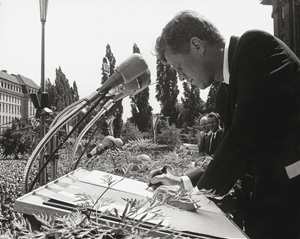
President John F. Kennedy signing the Golden Book of the City of Berlin. 1963. Vintage gelatin silver print on Agfa paper. 23,8 x 29,9 cm. 2 photographer's/copyright stamps, annotated and dated in pencil on the verso.
In 1937, the Jewish photographer Max Jacoby fled his native Koblenz for Argentina, where he began working as a camera assistant to photographer Georges Friedmann and later co-founded the photographic collective La Carpeta de los Diez with fellow émigré photographers. Returning to Berlin in 1957, he established himself as a freelance photographer, documenting political events, everyday life and a wide range of personalities in the divided city. His photographs of John F. Kennedy's historic visit to West Berlin in June 1963 capture the atmosphere of public enthusiasm surrounding the American president's appearance, providing a vivid record of a defining moment in the city's Cold War history.
Literatur: GDKE, Landesmuseum Koblenz, ed. Max Jacoby. Leben und Werk eines jüdischen Fotografen. Cologne: Wienand, 2020, ill p. 61 (images from the same series).
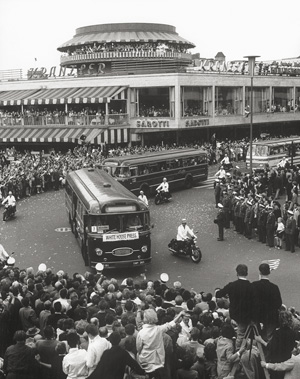
Jacoby, Max
Crowds lined up at Kranzlereck during John F. Kennedy's visit to Berlin
Los 4181
Schätzung
1.000€ (US$ 1,149)
Crowds lined up at Kranzlereck during John F. Kennedy's visit to Berlin. 1963. Vintage gelatin silver print on Agfa paper. 29,9 x 23,8 cm. Photographer's stamp and annotated as well as dated in pencil on the verso.
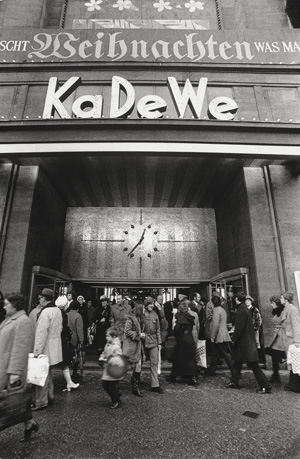
Kaufhaus des Westens (KaDeWe). Early 1970s. Vintage gelatin silver print on Agfa paper. 40 x 26,1 cm. Photographer's stamp on the verso.
Installed during the post-war reconstruction of Berlin's famous KaDeWe department store in the 1950s, the distinctive square clock above its main entrance became a familiar West Berlin landmark and a symbol of the Wirtschaftswunder (economic miracle). For decades, it served as a popular meeting point, giving rise to the familiar phrase "Let's meet under the clock at KaDeWe". The clock was eventually removed during a major renovation in the mid-1990s to make way for today’s modern glass facade.
Literatur: Angelika Gause, ed. Der Fotograf Max Jacoby: Bilder der 60er und 70er Jahre, Koblenz: Görres, 2003.
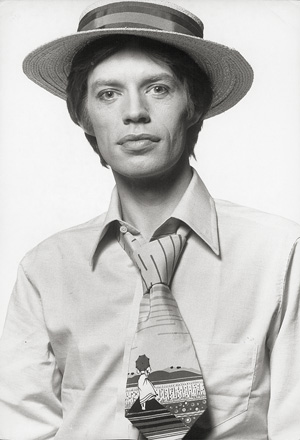
Photographers: Terry O'Neill (1938-2019) and Bob Whitaker (1939-2011). Mick Jagger. 1970, 1974. 2 vintage gelatin silver prints. 25 x 17,2 cm and 28,6 x 20,5 cm. Each with typed press text label and 2 agency stamps on the verso.
The portrait by Terry O'Neill was taken shortly before the release of The Rolling Stones album "It's Only Rock and Roll" in 1974. The photograph by Bob Whitaker shows Mick Jagger in the title role in the film Ned Kelly.
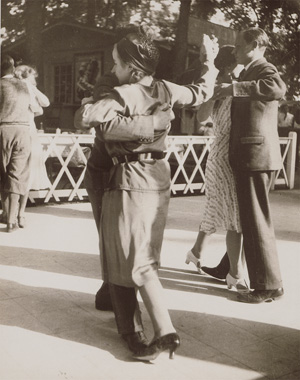
In der Freiluft-Tanzdiele; Tanz im Freien. Early 1930s. 2 vintage gelatin silver prints. 20,8 x 16,5 cm and 13 x 17,8 cm. Both with photographer's stamps and titled by the photographer in pencil on the verso.
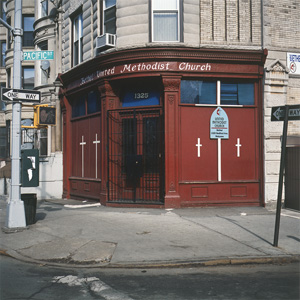
"New York Storefront Churches" portfolio. 2008. 24 chromogenic prints. Each circa 22,8 x 22,8 cm (sheet 35,3 x 27,8 cm). Each signed, editioned and dated by the photographer in black ink on the verso. Edition of 10 and 2 artist's proofs. Published in New York in 2012. With title page and list of titles with colophon, signed by the artist. Presented in original gray linen clamshell case with black-stamped title on the front cover (37,5 x 29,3 cm).
Charles Johnstone's work has been influenced by the American "New Topographics" photographers of the 1970s, whose restrained approach changed perceptions of the urban landscape, as well as by the conceptual artist Ed Ruscha. He has also long admired Luigi Ghirri, particularly for his use of color. On his walks through New York, Johnstone found inspiration in the makeshift storefront churches he encountered, with their colorful, often worn facades. Bringing together an array of these churches, each with its own distinct character, the portfolio records a distinctive and potentially disappearing aspect of the city's religious and architectural landscape.
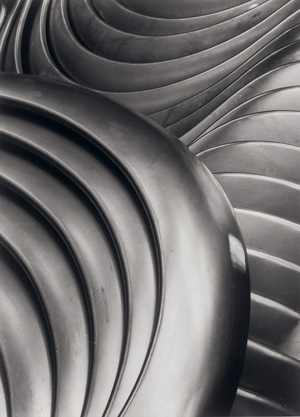
Peter Keetman. Portfolio Nr. 2 (Volkswagenwerk). 1951-53. 5 ferrotyped gelatin silver prints, printed 1984. Various sizes, circa 17 x 22 cm and 23,5 x 17,1 cm (sheet 23,8 x 30,8 cm) and reverse. Each signed by the photographer in black ink and editioned "6/50" on the verso. Presented in original black linen clamshell box with printed text sheet and embossed title on front cover. Edition CCD-Galerie, Düsseldorf 1984.
Peter Keetman’s 1951-53 series Volkswagenwerk offers a strikingly modernist view of the Volkswagen factory, transforming car parts and assembly lines into rhythmic, abstract compositions. Blending industrial subject matter with formal experimentation, the series exemplifies Keetman’s role in the postwar Fotoform movement and how he redefined the aesthetic potential of industrial photography.
Literatur: Holger Broeker, ed. Peter Keetman: Volkswagenwerk 1953. Bielefeld: Kerber, 2003, ill. pp. 23, 117, 121 and 137.
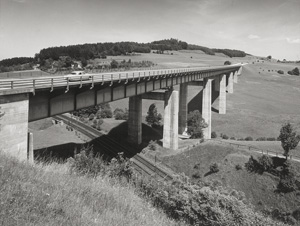
Autobahnbrücke bei Bergen (Mehn-Salzburg). 1950s. Vintage ferrotyped gelatin silver print on Leonar paper. 18,2 x 24 cm. Photographer's stamp and annotated in pencil on the verso.
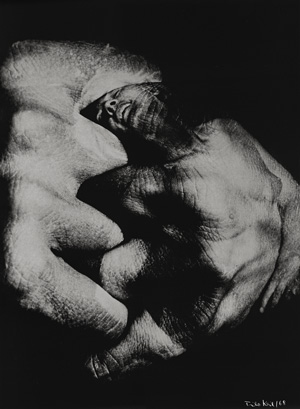
Umarmung (Embrace). 1968. Vintage half-tone print. 40,1 x 29,3 cm. Estate stamp on the verso.
A rediscovered figure in postwar German photography, Tilo Keil produced his distinctive body of work over a period of just three years. This unusual erotic montage belongs to his series "Hautbilder" (Skin Pictures), 18 works from which were exhibited at the Avant Art Galerie Casa in Munich in 1968.
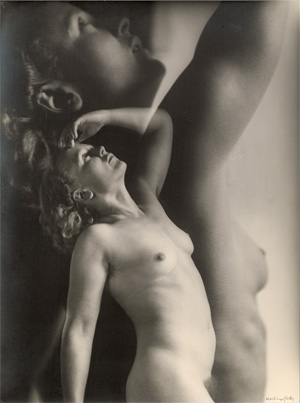
Female nude (double exposure). 1930s. Vintage gelatin silver print on Agfa-Brovira paper. 23,9 x 17,8 cm. Signed by the photographer in pencil in lower right corner; photographer's "Kestingfoto, Dresden A 24, Mommsenstr. 5 Ruf 46425" stamp on the verso.
The German photographer, painter and professor Edmund Kesting is associated with Expressionism and New Vision photography, his work bridges avant-garde experimentation and formal abstraction. From the 1920s onwards, he employed techniques such as multiple exposure, photograms and solarisation to create dynamic portraits, nudes and abstract compositions.
[*]: Regelbesteuert gemäß Auktionsbedingungen. [^]: Ausgleich von Einfuhr-Umsatzsteuer.
* Alle Angaben inkl. 25% Regelaufgeld ohne MwSt. und ohne Gewähr – Irrtum vorbehalten.
Galerie Bassenge
Erdener Str. 5A
14193 Berlin
Öffnungszeiten:
Montag bis Donnerstag, 10–18 Uhr,
Freitag, 10–16 Uhr
Telefon: +49 30 8938029-0
Fax: +49 30 8918025
E-Mail: info (at) bassenge.com
Impressum
Datenschutzerklärung
© 2026 Galerie Gerda Bassenge
Galerie Bassenge
Erdener Str. 5A
14193 Berlin
Öffnungszeiten:
Montag bis Donnerstag, 10–18 Uhr,
Freitag, 10–16 Uhr
Telefon: +49 30 8938029-0
Fax: +49 30 8918025
E-Mail: info (at) bassenge.com
Impressum
Datenschutzerklärung
© 2026 Galerie Gerda Bassenge