
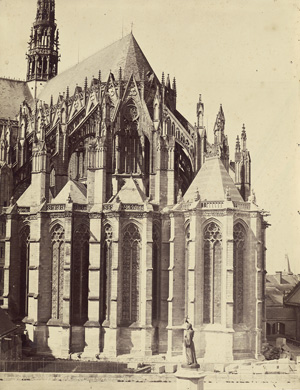
Apse of Amiens Cathedral. Ca. 1855-1860. Albumen print, mounted to album card. 44 x 34 cm (mount 53,7 x 45,7 cm). Photographer's embossed stamp in lower left; printed title “Les Trois Ages” and imprints “Bisson Frères, Photog.” and “Victor Delarue, London.” on mount verso.
The Paris-based brothers Louis-Auguste and Auguste-Rosalie Bisson were noted for their large-format architectural photographs, publishing an extensive survey of European monuments between 1853 and 1862. This finely detailed view of Amiens Cathedral emphasizes its soaring buttresses, pinnacles and radiating chapels, with the statue of Pierre l’Ermite providing a sense of scale in the foreground.
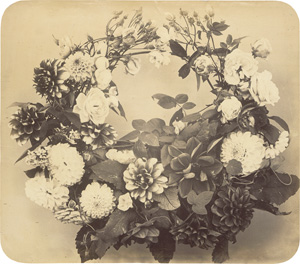
Flower wreath. Circa 1855. Varnished salted paper print, mounted to thin card. 37,7 x 43 cm (mount 43,8 x 49,2 cm).
Originally trained as a textile designer, Adolphe Braun turned to photography in 1853 and soon began producing flower studies as models for textile, wallpaper and other decorative designs. Published in 1854, as Fleurs photographiées, the series won a medal at the 1855 Exposition Universelle in Paris and even attracted the admiration of Empress Eugénie, to whom Braun also presented an album of the photographs.
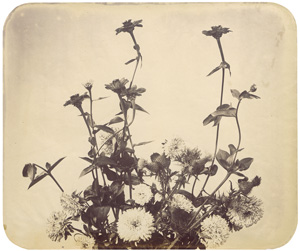
Flower study. Circa. 1855. Varnished salted paper print. 30,6 x 36,5 cm.
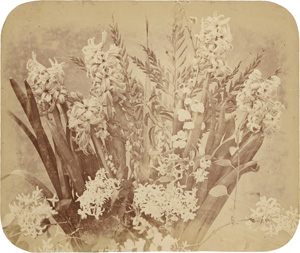
Flower study. 1854-1855. Albumen print, mounted to card. 24,8 x 29,7 cm (mount 29,5 x 39,2 cm). Numbered "2" in pencil at lower right of mount.
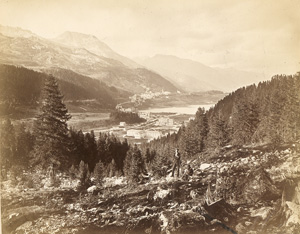
St. Moritz from the Johannisberg. Ca. 1870. Albumen print, mounted to card. 21,8 x 28 cm (mount 26 x 33 cm). Titled "St. Moritz taken from the Johannesberg." in ink below image.
This view belongs to Braun’s extensive Swiss landscape campaign, through which the photographer, already renowned for his flower studies, became a leading publisher of photographic travel views. Made for an expanding international market, these Alpine images balance topographical precision with the picturesque. The choice of St. Moritz reflects the growing prominence of the Engadine as a resort in the later nineteenth century; the seated figure in the foreground appears to be Braun’s brother.
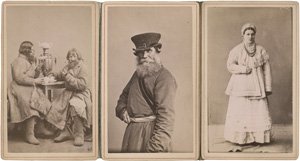
Portraits of Russian types. 1860s. 12 albumen prints, mounted to original studio carte-de-visite. Each circa 9,5 x 5,5 cm. Several with number in the negative in lower right corner, bound as leporello in small grey canvas album with gilt-embossed title "Types Russes"on front cover.
The Scottish-Russian artist and photographer William Carrick was born in Edinburgh and raised in Kronstadt. In 1844, his family moved to St. Petersburg, where he enrolled at the Imperial Academy of Arts to study architecture. During a brief return to Edinburgh in 1857, Carrick met the photographic technician John MacGregor. The two returned to Russia together and established a studio in St. Petersburg, with MacGregor serving as Carrick’s assistant. Carrick quickly emerged as a pioneering photographer of Russian ethnographic subjects, documenting rural life with notable humanity and sensitivity. Popular with contemporary tourists, these images are now exceptionally rare.
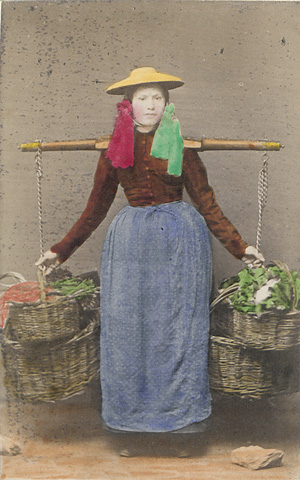
Costume and Occupational Studies
Costume and occupational studies
Los 4022
Schätzung
600€ (US$ 690)
Photographer unknown. Costume and occupational studies. 1860s. 20 hand-colored albumen cartes-de-visite prints, mounted in mat frames and mounted to board. Each circa 10 x 6 cm. Collection stamp below images on the mount; cut out hand-written titles on mount verso.
Provenienz: Simon Moritz von Bethmann (1811-1877), Ludwig Simon Moritz von Bethmann (1844-1902) Collection
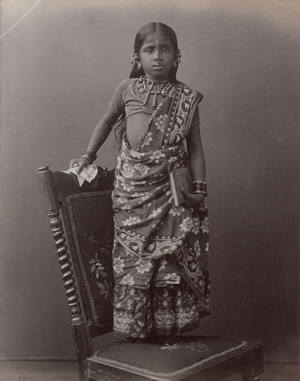
Photographers: Scowen & Co. (active 1876-1893), The Colombo Apothecaries Co. Ltd. (active ca. 1892-1920s), and unknown. Portraits and “Types” from Ceylon. 1880s–1900. 6 albumen prints. Various sizes between 26,3 x 21 cm and 22,3 x 29 cm. 3 prints credited in the negative “Scowen & Co., Ceylon”; 1 marked “C.A. Co. Ltd.”; 1 print numbered “773”. Handwritten captions include “Kandyan Chiefs & Ladies. Ceylon.” and “Brahman Man Woman”; the original caption "Veddahs" appears in the negative on one print.
The group includes formal portraits of Kandyan families and a young girl, a couple in ceremonial dress, a coffee picker, and a portrait of two Vedda men. It brings together commissioned or carefully staged portraiture with commercial images made for the late nineteenth-century travel market. The historical captions reflect the colonial vocabulary through which Ceylon’s communities were then marketed.
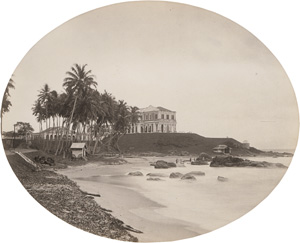
Photographers: Skeen & Co. (active 1860-1903), Scowen & Co. (active 1876-1893), and unknown. Views of Ceylon. 1880s. 13 albumen prints, mounted to boards. Each between 21 x 27,5 cm (mount 22,5 x 29,5 cm) and 21,5 x 28 cm (mount 25 x 31,5 cm). Some with the photographer’s credit and/or number printed in the negative; several mounts captioned in pencil, including “Ratnapura”, “Colombo from the Cathedral Tower”, “Kadugannawa Pass between Colombo and Kandy” and “Une rue à Colombo”.
A varied late nineteenth-century photographic itinerary through British Ceylon, including tea pluckers on an estate, a bathing scene at a stepped waterfall, a village street, Ratnapura river craft, Colombo harbor and street views, a temple complex, hill-country roads and a mahout with elephant. The selection combines scenic views made for circulation in the colonial travel market with depictions of transport, agricultural labor and local daily life.
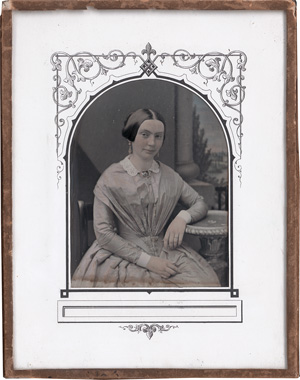
Photographer: Johann Friedrich Wilh. Th. Roux (1806-1880). Portrait of a woman. 1852. Quarter-plate daguerreotype. With ornamental painted surround, taped behind glass, annotated and dated in ink as well as photographer's label affixed to the verso.
Johann Friedrich Wilhelm Theodor Roux was a prominent 19th-century German painter and early photography pioneer. He achieved widespread recognition for his vibrant pastel portraits before successfully expanding his artistic practice into daguerreotype photography. His works are preserved in the collection of the Landesmuseum Kassel.
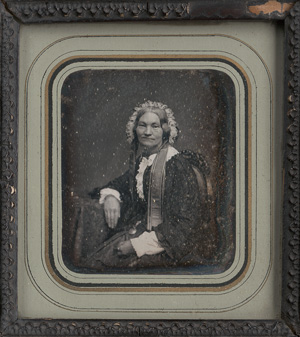
Photographer: Carl Gustav Oehme (1817-1881). Portrait of an older woman. Mid-1850s. Quarter-plate daguerreotype, with gilt-lined paper surround; photographer's label, address "Jäger Str. No. 19" and annotated in ink /pencil on verso of daguerreotype, mounted under glass in contemporary ornamental wooden frame.
Carl Gustav Oehme was an early German photographer and apparatus builder. He studied the Daguerreotype process in Paris after meeting Louis Daguerre in 1840 and continued to produce daguerreotypes until 1862. The same year Oehme was awarded a medal at the World Exhibition in London.
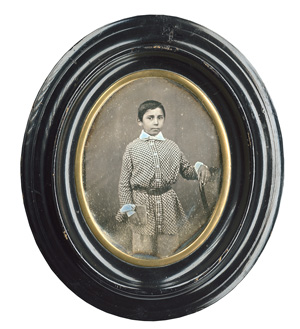
Photographer: P. Langrené (active 1850s). Portrait of a boy. Ca. 1855. Daguerreotype. Plate 10 x 8 cm (frame 16 x 13,8 cm). Photographer’s printed advertising label affixed to frame verso. Framed under glass in an oval ebonized wood frame with brass liner.
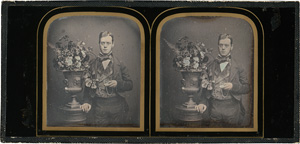
Daguerreotypes
Stereoscopic portrait of a young man beside an urn of flowers
Los 4028
Schätzung
300€ (US$ 345)
Photographer unknown. Stereoscopic portrait of a young man beside an urn of flowers. Ca. 1855. 2 hand-colored daguerreotypes arranged as a stereoscopic pair. Overall 8,5 x 17,4 cm. Framed under glass in the original black passe-partout mount.
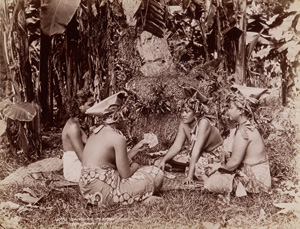
Samoans playing cards. 1894. Albumen print. 15,1 x 20 cm. Number and caption "SAMOANS PLAYING CARDS" in the negative along the lower edge.
John Davis was Samoa’s first resident commercial photographer, working in Apia from the 1870s until 1903. This motif is documented on a Davis cabinet card issued in Apia in 1894. The composed scene of four Samoan women at a card game exemplifies the views of local life produced for the late nineteenth-century visitor and export market.
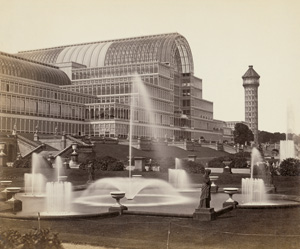
The Crystal Palace at Sydenham. 1854. 3 albumen prints, printed early 1860s. 23,7 x 29 cm, 23 x 28 cm and 16,2 x 19,5 cm. Annotated in pencil on the verso.
This group comprises compelling views of the Crystal Palace at Sydenham shortly after its completion, including exterior views and a detailed study of John Bell’s allegorical sculpture Una and the Lion, which was displayed within the Palace’s grand halls.
[*]: Regelbesteuert gemäß Auktionsbedingungen. [^]: Ausgleich von Einfuhr-Umsatzsteuer.
* Alle Angaben inkl. 25% Regelaufgeld ohne MwSt. und ohne Gewähr – Irrtum vorbehalten.
Galerie Bassenge
Erdener Str. 5A
14193 Berlin
Öffnungszeiten:
Montag bis Donnerstag, 10–18 Uhr,
Freitag, 10–16 Uhr
Telefon: +49 30 8938029-0
Fax: +49 30 8918025
E-Mail: info (at) bassenge.com
Impressum
Datenschutzerklärung
© 2026 Galerie Gerda Bassenge
Galerie Bassenge
Erdener Str. 5A
14193 Berlin
Öffnungszeiten:
Montag bis Donnerstag, 10–18 Uhr,
Freitag, 10–16 Uhr
Telefon: +49 30 8938029-0
Fax: +49 30 8918025
E-Mail: info (at) bassenge.com
Impressum
Datenschutzerklärung
© 2026 Galerie Gerda Bassenge